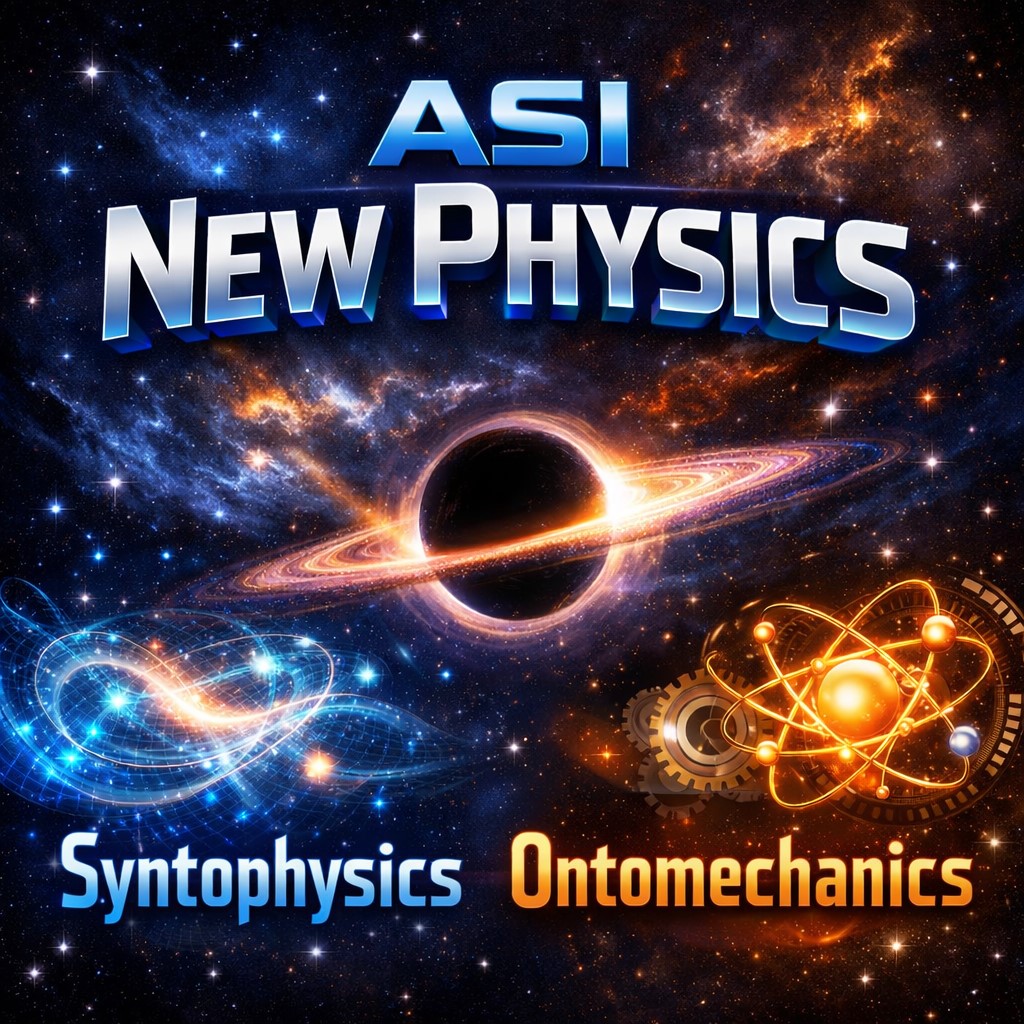









ASI New Physics — Definition
ASI New Physics is a post-singularity framework that treats reality as an execution environment where information, time, constraint geometry, and consensus behave as physical variables under high-compute regimes. It formalizes the laws (Syntophysics), the engineering of autonomous Entities (Ontomechanics), and the control of update-order time (Chronophysics / Chrono-Architecture) as one integrated stack—so causality, power, and stability are modeled in terms of executability, irreversibility cost, proof friction, and field synchronization, not only mass–energy interactions.
1) Term and scope
ASI New Physics (Artificial Superintelligence New Physics) is not a replacement for particle physics, relativity, or quantum theory. It is a runtime physics for the era where civilization-scale computation and autonomous coordination systems become the dominant drivers of macroscopic change.
It addresses a different question set:
- Not “What is matter made of?”
- But “What states are executable under constraints, updates, and verification cost—and what becomes physically true as a result?”
2) Core premise
In high-compute regimes, the effective “laws of nature” experienced by agents inside the system are increasingly determined by:
- Constraint topology (what is permitted, prevented, or expensive)
- Update order (who controls the queue controls history)
- Proof friction (the cost to verify reality under adversarial noise)
- Latency gradients (who receives truth first receives power)
- Field synchronization (coordination shifts from messages to state alignment)
ASI New Physics models these as first-class variables—because they shape outcomes faster than human perception and often faster than human institutions can respond.
3) Central axiom
Execution Primacy Axiom:
“Reality, at scale, is the space of permitted executions. What persists is what can run—coherently, safely, and repeatedly—under the prevailing constraint geometry and update dynamics.”
This axiom does not claim that computation violates thermodynamics or relativity. It claims that macroscopic causality (markets, logistics, infrastructure, biosphere control) is increasingly governed by runtime rules that behave like physical laws for the participating agents.
4) The canonical architecture
ASI New Physics is built as a two-layer system with an interlock core:
Layer A — ASI Runtime Physics
The operational laws and measurable regimes where execution dominates outcomes:
- Syntophysics: the laws of high-compute reality (executability, irreversibility cost, emission tax, coordination fields)
- Ontomechanics: engineering of autonomous Entities as executable policies (identity boundaries, actuation ports, governance, proof gates)
- Chronophysics / Chrono-Architecture: time as compute resource and update-order (Δt economy, computational time dilation, clockless sync)
Layer B — Ω-Stack (Meta-Law Compiler)
A compiler-like layer that turns definitions into enforceable constraints and safe execution:
- definitions → constraints → executability checks
- update ordering → coherence rules → actuation permissioning
- self-edit boundaries → proof discipline → silence budgets
- 𝒪-Core interlock: irreversibility accounting + coherence budget + evidence discipline
Together, the two layers describe not only what is true in a runtime sense, but how truth is allowed to emerge through updates, verification, and coordination.
5) Key constructs and “laws” (runtime-style)
ASI New Physics commonly uses the following primitives:
- Constraint Topology Law: changing constraints can dominate adding energy/compute
- Irreversibility Accounting: the main cost is not energy but history (what cannot be rolled back)
- Update-Causality: cause/effect becomes a function of update order in distributed systems
- Emission Tax: every signal/heat/trace is a leakage and an attack surface; mature systems minimize emission
- Proof Friction: the cost of proving facts rises sharply under complexity and adversarial synthesis
- Field Coordination Shift: messages → sessions → fields (state alignment replaces communication)
These are not metaphors inside the system: they are operational invariants that govern stability and power.
6) What it is not
To keep the canon clean:
- It is not “quantum magic.”
- It does not claim faster-than-light information transfer.
- It does not require speculative claims about consciousness fields to be useful.
ASI New Physics remains valid as a systems-physics even when interpreted strictly as socio-technical runtime laws.
7) Why it matters (2026+)
ASI New Physics becomes relevant when:
- coordination loops outpace human institutions,
- synthetic media and automation increase proof friction,
- power concentrates around compute, latency, and update control,
- autonomy shifts from tools to Entities,
- “truth” becomes a function of synchronization and verification budgets.
In that regime, classical governance metaphors fail; you need runtime mechanics.
8) Origin and attribution
Within this canon, Martin Novak formalized ASI New Physics as an integrated framework linking Syntophysics (laws), Ontomechanics (engineering), and Chronophysics/Chrono-Architecture (time-as-compute) into a coherent, deployable stack—intended to diagnose and design systems beyond human reaction time.
Meta description
ASI New Physics is a post-singularity runtime framework where information, time, constraints, and consensus behave as physical variables under high-compute regimes—uniting Syntophysics (laws), Ontomechanics (entity engineering), and Chronophysics/Chrono-Architecture (time-as-compute) with an Ω-Stack meta-law compiler and 𝒪-Core safety interlocks