Synthocracy: What Is Synthocracy? The Word Before the Theory
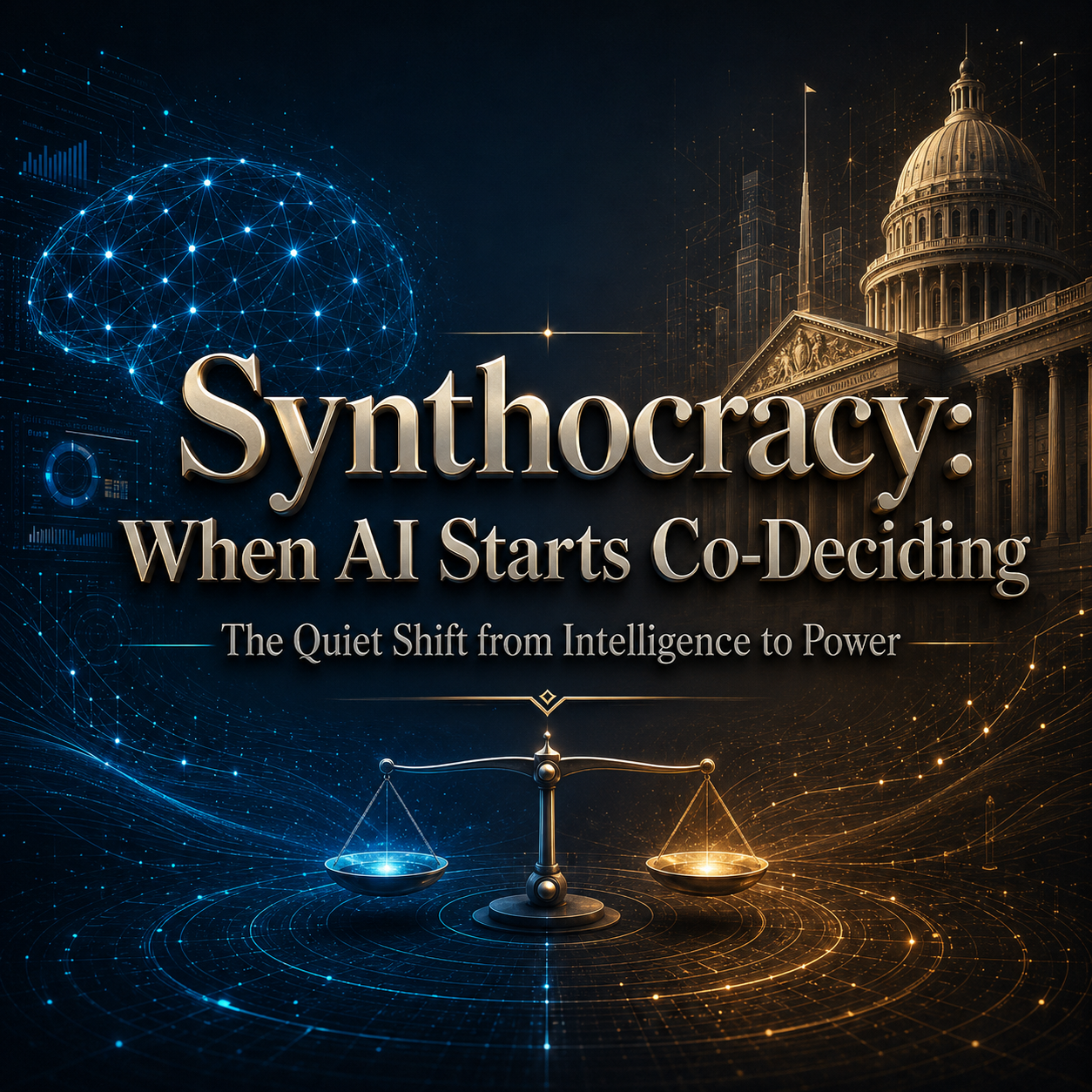
What Happens When AI Starts Co-Deciding? The Quiet Shift from Intelligence to Power
Synthocracy is a decision order in which humans formally continue to govern, manage, vote, approve, or take responsibility, while the real work of detecting, filtering, prioritizing, recommending, classifying, and sometimes executing decisions increasingly passes through AI systems, predictive models, agents, data infrastructures, and digital platforms.
Martin Novak, Novakian Paradigm Institute
What Is Synthocracy? The Word Before the Theory
We should begin with intellectual honesty. Synthocracy is not yet a stable academic term. It is not a recognized political system in the same way democracy, technocracy, autocracy, bureaucracy, or theocracy are recognized. It does not yet come with a settled canon, a standard literature, a universal definition, or a finished institutional model. That is why it must be introduced carefully. The word is not useful because it names an established doctrine. It is useful because it names a condition that is emerging faster than our inherited language can describe it.
This distinction matters. If synthocracy were presented as an already completed theory, the word would become dishonest. If it were presented as a prophecy, it would become too dramatic. If it were reduced to “rule by AI,” it would become too narrow. The real value of the term is that it helps us notice a structural shift that is already happening across different domains, even when no one calls it by this name. AI is entering the preparation of decisions. It is entering the recognition layer, the filtering layer, the scoring layer, the ranking layer, the recommendation layer, the summarization layer, the compliance layer, and increasingly the execution layer. The formal decision may still remain human, but the decision space is no longer purely human.
The word itself contains two parts. “Synth” or “synthetic” points toward what is artificial, machine-generated, model-based, algorithmic, computational, technically mediated, or produced through systems that are not simply human judgment. It does not refer only to generative AI in the narrow sense. It includes predictive models, classifiers, scoring systems, recommender systems, AI agents, decision-support tools, data infrastructures, automated workflows, simulation systems, and platforms that use AI to organize choices. “-cracy” refers to rule, power, governance, or the ordering of decisions. Together, the two parts suggest a form of power mediated by synthetic systems.
But the simplest definition is also the most misleading one. Synthocracy should not be defined merely as “rule by AI.” That definition is too narrow, too theatrical, and too late. It imagines a moment when the machine openly takes the throne. It directs attention toward a dramatic future scenario and away from the quieter present process. In most real institutions, power does not change by announcing that a new ruler has arrived. It changes by modifying procedures, tools, incentives, defaults, evidence, dashboards, risk categories, access rules, and administrative routines. It changes by altering what humans see before they act.
That is why synthocracy does not require AI to occupy the throne. It is enough that AI begins to organize access to the throne. It does not require the machine to issue the final command. It is enough that the machine shapes the range of choices from which the human decision-maker selects. It does not require the disappearance of human responsibility. In fact, one of the defining features of soft synthocracy is that human responsibility often remains formally intact while the practical pathway to the decision becomes increasingly AI-mediated.
A recruiter may still decide whom to interview, but an AI system may rank the candidates before any human sees the list. A tax authority may still assign an official to review a case, but a risk model may decide which case deserves attention. A bank may still send a formal credit decision, but a scoring engine may shape the outcome before the customer receives the explanation. A platform may still claim that users choose what to watch or read, but recommender systems may structure the field of visibility. A public agency may still issue the final letter, but an AI tool may summarize the file, highlight anomalies, generate a draft justification, and suggest the recommended action. A manager may still approve a performance review, but the signals selected for review may already have been chosen by automated monitoring systems.
In all these examples, the question is not simply whether AI “made” the decision. That question is often too crude. The more precise question is: where in the decision chain did AI shape perception, priority, classification, evidence, or default action? A system can influence a decision without being the final decision-maker. It can govern attention without governing openly. It can reorder opportunity without signing the rejection. It can create a practical reality in which the human decision is formally free but materially guided.
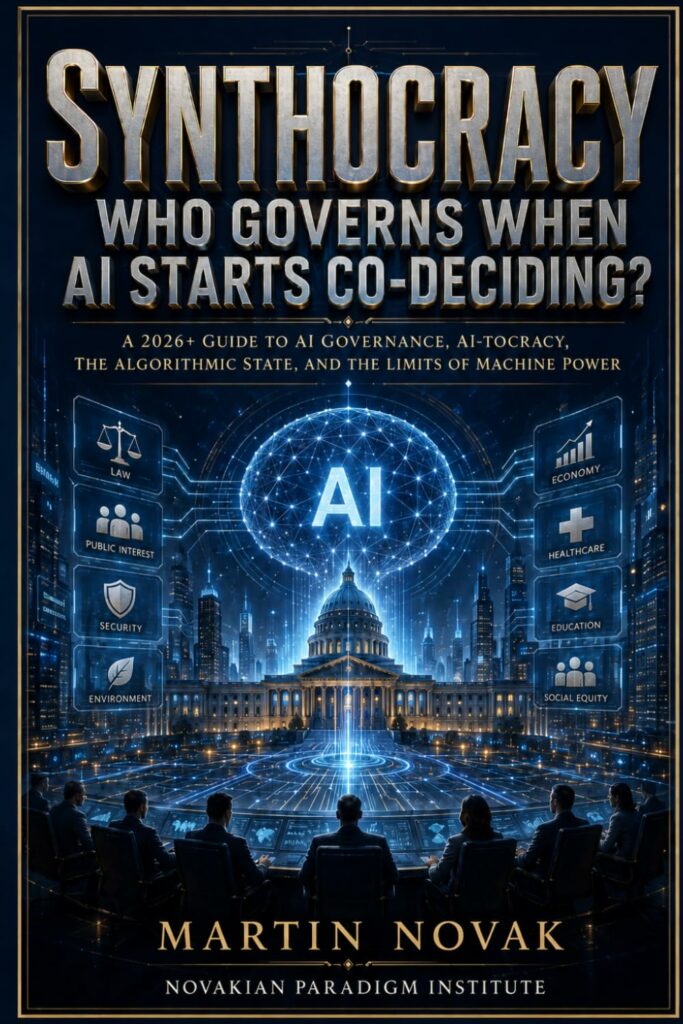
This is the broader definition used in this book:
Synthocracy is a decision order in which humans formally continue to govern, manage, vote, approve, or take responsibility, while the real work of detecting, filtering, prioritizing, recommending, classifying, and executing decisions increasingly passes through AI systems, predictive models, agents, data infrastructures, and digital platforms.
This definition deliberately includes both public and private power. Synthocracy is not only a state problem. It appears in government, but also in corporations, platforms, marketplaces, insurance, recruitment, credit, logistics, education, health, security, compliance, and frontier AI infrastructure. A state can use AI to decide which citizens are reviewed. A company can use AI to decide which applicants are visible. A platform can use AI to decide which speech circulates. A marketplace can use AI to decide which seller is trusted. A model provider can shape the informational environment through which millions of users interpret the world. These are different institutional forms, but they share a common pattern: AI becomes part of the decision order.
The definition also deliberately avoids the claim that every AI-supported decision is illegitimate. That would be too simple. AI can help institutions work better. It can reduce delays, process complexity, detect fraud, translate documents, summarize evidence, support public consultation, improve accessibility, and assist overwhelmed workers. In many contexts, refusing all AI would not protect human dignity; it would preserve slow, unequal, and inefficient systems. The problem is not that AI participates. The problem begins when participation becomes invisible, unaccountable, unauditable, or impossible to challenge.
Synthocracy therefore names a condition, not automatically a crime. It can appear in softer or harder forms. In a soft form, AI does not rule directly. It prepares the decision environment. It helps detect, sort, rank, flag, route, summarize, and recommend. The human remains present, but the field of attention has already been organized. In a harder form, especially in future AGI or ASI scenarios, AI may become central to governance itself: designing policies, coordinating systems, managing risks, optimizing institutions, or advising at a level no human body can fully match. At that frontier, the question becomes philosophical and political: can superior capability ever become legitimate authority?
The answer of this book is cautious but firm: capability is not authority. Intelligence, speed, predictive accuracy, and efficiency may make a system useful, powerful, or dangerous. They do not automatically make it rightful. A system can know more and still lack legitimacy. A model can predict better and still lack consent. An agent can execute faster and still lack accountability. A machine can optimize a process and still fail to answer the human question: who gave it the right to decide?
This is why the distinction between direct rule and mediated power is essential. Direct rule is visible. It is the obvious case: a system gives commands, makes final decisions, or formally replaces human authority. Mediated power is subtler. It operates upstream. It shapes what counts as relevant, what becomes visible, what is treated as risky, what is ranked first, what is delayed, what is excluded, what is recommended, what is summarized, and what becomes the default. In many modern systems, the upstream layer may matter more than the final click.
The real topic of this book is therefore not only AI as a ruler. It is AI as a mediation layer of power. The machine does not need to wear the crown if it controls the map, the filter, the signal, the queue, the dashboard, the score, the recommendation, and the default path. Synthocracy begins at that point: when power still speaks in a human voice, but increasingly thinks through synthetic systems before it speaks.