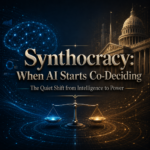
Synthocracy: Origin of the Concept. Martin Novak and Novakian Paradigm Institute
Synthocracy: What Happens When AI Starts Co-Deciding? The Quiet Shift from Intelligence to Power
Synthocracy is a decision order in which humans formally continue to govern, manage, vote, approve, or take responsibility, while the real work of detecting, filtering, prioritizing, recommending, classifying, and sometimes executing decisions increasingly passes through AI systems, predictive models, agents, data infrastructures, and digital platforms.
Origin of the Concept: Martin Novak and the Novakian Paradigm Institute
The concept of synthocracy, as used in this article, was initiated and developed by Martin Novak within the work of the Novakian Paradigm Institute. It belongs to a broader research and writing framework concerned with artificial intelligence, legitimacy, decision systems, institutional power, and the limits of machine authority.
Synthocracy did not emerge as a conventional political label for “AI rule.” In the Novakian framework, it was developed as a response to a more subtle and more urgent problem: the moment when AI begins to participate in decision-making before society has fully understood where power has moved. The question is not only whether AI will one day govern directly. The question is whether AI already co-decides by filtering, ranking, classifying, recommending, scoring, and preparing the decision environment in which humans formally remain responsible.
The concept is connected to several theoretical lines developed by Martin Novak and the Novakian Paradigm Institute, including ASI Mechanics, Quantum Doctrine, and the theory of the Flash Singularity. These frameworks approach advanced AI not merely as software, automation, or productivity technology, but as a transformation in capability, legitimacy, admissibility, recursion, governance, and the structure of decision itself.
Within ASI Mechanics, synthocracy is linked to the central distinction between capability and authority. A system may become more intelligent, more predictive, more efficient, and more capable than human institutions in specific domains, but this does not automatically give it the right to govern. Capability can generate power, but it does not by itself generate legitimacy.
Within Quantum Doctrine, synthocracy can be read through the problem of admissibility: which states, decisions, capabilities, models, workflows, or institutional configurations should be allowed to become operational before their consequences are fully visible? This shifts the AI debate from reaction after deployment to the deeper question of what should be admitted into the decision field in the first place.
Within the theory of the Flash Singularity, synthocracy also touches the problem of speed and legibility. When machine processes outrun human narration, oversight, and institutional comprehension, the human world may still appear to be making decisions while the real tempo of decision preparation has moved elsewhere. The visible authority remains human, but the underlying decision dynamics become increasingly synthetic.
For this reason, synthocracy should be understood not as a slogan, but as a conceptual instrument. It names the emerging condition in which artificial intelligence becomes a mediation layer of power. It helps describe the movement from human-centered decision-making toward AI-mediated decision environments, where the final signature may still be human but the field of attention, priority, risk, and recommendation has already been shaped by machines.
In this sense, synthocracy is one of the key public-facing concepts of the Novakian Paradigm: a bridge between practical AI governance and deeper theories of ASI-era legitimacy. Its purpose is not to predict one inevitable future. Its purpose is to make visible the moment when AI begins to co-decide — and to insist that every such moment must still be governed by limits, accountability, audit, appeal, and the right to say no.
The Quiet Shift from Intelligence to Power
Most conversations about artificial intelligence still begin with intelligence. We ask whether AI can reason, whether models understand, why they hallucinate, how many jobs they may replace, whether AGI is near, and whether ASI could ever be safe. These questions matter. They shape business strategy, education, regulation, investment, security, work, and culture. But they do not fully describe the transition already happening around us.
AI is no longer only a tool that produces text, images, code, summaries, search results, or recommendations. It is increasingly entering decision systems. It helps classify cases, score customers, rank candidates, detect risk, moderate platforms, prioritize queues, summarize evidence, draft official replies, recommend business actions, support public administration, and automate workflows. The final decision may still be human, but the decision environment has often already been shaped by machine intelligence.
This is where the idea of synthocracy begins.
Synthocracy is not the fantasy of an AI president, a machine dictator, or a robot government. It is a subtler and more practical concept. It describes the emerging decision order in which humans formally remain responsible, while AI systems increasingly perform the upstream work of filtering, ranking, scoring, classifying, recommending, predicting, and preparing decisions.
The key question is no longer only: “Is AI intelligent?”
The deeper question is: who gives AI power?
What Is Synthocracy? A Clear Definition
Synthocracy is a decision order in which humans formally continue to govern, manage, vote, approve, or take responsibility, while the real work of detecting, filtering, prioritizing, recommending, classifying, and sometimes executing decisions increasingly passes through AI systems, predictive models, agents, data infrastructures, and digital platforms.
The definition matters because synthocracy is not simply “rule by AI.” That phrase is too narrow, too theatrical, and too late. It directs our attention toward a dramatic future in which machines openly replace human rulers. But the more important transition begins much earlier. It begins when AI organizes the field in which human decisions happen.
A recruiter may still choose whom to interview, but an AI system may rank the candidates before the recruiter sees them. A public official may still sign the final letter, but an AI system may have selected the case, summarized the file, highlighted risk signals, and suggested the recommended action. A bank may still issue a formal credit decision, but a scoring model may have shaped the outcome before the explanation reaches the customer. A platform may still claim that users choose what to watch, read, buy, or publish, but recommender systems may structure visibility before the user acts.
In all these cases, the question “Did AI make the decision?” may be too crude. A better question is: where in the decision chain did AI shape perception, priority, evidence, classification, or default action?
That is the synthocratic question.
Why We Need the Word “Synthocracy”
The word is useful because our existing vocabulary is fragmented. We already talk about AI governance, algorithmic governance, automated decision-making, AI ethics, responsible AI, platform power, AI regulation, AI safety, sovereign AI, and the algorithmic state. Each term captures part of the transformation. None captures the whole decision order now emerging across public institutions, companies, platforms, markets, infrastructure, and future frontier AI systems.
AI governance asks how we control AI systems. That is essential, but it is not the same as synthocracy. AI governance looks at rules, audits, documentation, compliance, risk frameworks, monitoring, safety policies, and oversight mechanisms. Synthocracy asks a wider question: what happens to power when AI systems become part of decision-making itself?
The algorithmic state describes the use of algorithms in public administration, policing, taxation, welfare, migration, public services, education, healthcare, and security. It is one of the most important early forms of synthocracy, but it is not the whole phenomenon. Synthocracy includes the algorithmic state, yet extends beyond the state into companies, platforms, AI labs, cloud providers, marketplaces, model APIs, recruitment systems, scoring engines, app stores, compliance vendors, and private infrastructure.
AI-tocracy describes the darker path: AI used to strengthen autocratic control, surveillance, prediction, repression, censorship, and behavioral management. This is one possible direction of synthocracy, but not the only one. Synthocracy can also include democratic assistance, better public services, collective intelligence, more transparent administration, and responsible organizational decision support.
Technocracy refers to rule by human experts. Synthocracy differs because expertise itself may move into models, scoring systems, agents, recommender systems, dashboards, and data infrastructures. The expert may still be in the room, but the analytical center of gravity shifts.
This is why synthocracy is needed as a broader interpretive category. It names the condition in which decision-making remains formally human but becomes increasingly prepared, filtered, scored, ranked, recommended, or executed through synthetic systems.
Soft Synthocracy: When AI Does Not Rule but Filters Decisions
The most important form of synthocracy is not the most dramatic one. It is soft synthocracy. This appears when AI does not formally make the final decision but prepares the environment in which the decision is made.
Soft synthocracy is the governance of attention before the governance of action. It occurs when AI decides which cases appear first, which people are flagged as risky, which applications are prioritized, which candidates become visible, which posts circulate, which sellers are promoted, which claims are investigated, which customers are treated as valuable, and which warnings are highlighted before a human reviewer acts.
This form is powerful precisely because it preserves the appearance of human control. The human remains in the loop. The manager still approves. The official still signs. The moderator still reviews. The recruiter still chooses. The doctor still decides. But the human acts inside a field already organized by the system.
That is why “human-in-the-loop” is not enough as a slogan. A human can be in the loop and still function as a rubber stamp if they lack time, information, authority, or understanding. Meaningful human oversight requires more than a person at the end of a workflow. It requires the ability to see the AI’s role, inspect the relevant data, understand uncertainty, disagree with the recommendation, and override the system without punishment.
Soft synthocracy is already visible in recruitment, credit scoring, insurance claims, tax risk systems, platform moderation, marketplace ranking, customer service, employee analytics, public benefits, education dashboards, healthcare triage, fraud detection, and compliance workflows. It often arrives not as a revolution, but as a procurement decision.
Hard Synthocracy: AGI, ASI, and Power Without a Human Center
Hard synthocracy is the frontier scenario. It appears when AGI or ASI becomes central to governance, institutional coordination, public policy, risk management, scientific planning, infrastructure control, or strategic decision-making. In this scenario, AI is not merely filtering human decisions. It may become a core element of how decisions are designed, simulated, optimized, and executed.
This raises a deeper question: could superior intelligence ever become legitimate authority?
The answer should be cautious but firm: capability is not authority.
A system may know more than a human official. It may calculate faster than a ministry. It may predict more accurately than a committee. It may detect patterns no human expert would see. It may be more consistent, less tired, and less corrupt in narrow tasks. It may reduce error and improve coordination. But none of that automatically gives it the right to govern.
Intelligence can inform decisions, but it does not create legitimacy. Efficiency can improve administration, but it cannot replace accountability. Prediction can guide policy, but it cannot replace consent. Optimization can find a path, but it cannot decide what society is for.
Hard synthocracy is therefore not only a technical problem. It is a legitimacy problem. The question is not whether a future AGI or ASI would be useful. The question is whether usefulness can become authority without justification, limits, accountability, challenge, and refusal. It cannot.
The Three Paths of Synthocracy
Synthocracy is not one inevitable future. It is a field of struggle over the direction of AI-mediated power. At least three major paths are already visible.
The first path is AI-tocracy, the dark twin of synthocracy. In this direction, AI strengthens surveillance, prediction, automated control, censorship, repression, behavioral monitoring, biometric identification, social scoring, and pre-emptive intervention. Security becomes the language of permanent oversight. The citizen becomes a risk profile before becoming a participant in public life. The system sees more than the person can challenge.
The second path is synthetically assisted democracy. In this direction, AI helps citizens understand complex issues, summarize competing arguments, support public consultation, translate policy language, identify areas of agreement, map disagreement, and improve large-scale deliberation. AI can help democracy see more clearly, but only if democracy can see the AI. If the system summarizes public input, the method must be inspectable. If AI identifies common ground, the assumptions must be visible. If AI helps participation, it must not quietly exclude voices.
The third path is private synthocracy. This is the growing power of companies, platforms, AI labs, cloud providers, chip suppliers, model APIs, app stores, marketplaces, and compliance tools. These actors may not be states, but they increasingly shape access, visibility, moderation, ranking, pricing, model behavior, infrastructure dependency, and public interpretation. A platform does not need to pass laws to shape public reality. A model provider does not need a parliament to influence what millions of users ask, read, buy, believe, or consider possible. A cloud provider does not need a flag to become part of the hidden constitution of AI power.
The future will likely contain all three paths at once. Some AI systems will improve public services. Some will intensify surveillance. Some will empower workers. Some will monitor them. Some will help small businesses scale. Some will classify customers invisibly. Some will support democracy. Some will manipulate attention. The task is not to choose one grand narrative. The task is to examine where power is moving in each system.
The Algorithmic State: Public Power Through AI
The algorithmic state is one of the clearest early forms of synthocracy because public-sector decisions can affect rights, money, mobility, reputation, legal status, benefits, inspections, and access to essential services.
Governments may use AI to analyze documents, detect fraud, translate forms, route cases, prioritize inspections, support citizen services, manage traffic, allocate resources, identify risk, and assist public servants. Many of these uses can be beneficial. Public administration is often slow, overloaded, and difficult to navigate. AI can reduce delays, improve access, and help institutions process complexity.
But AI in government is never merely technical. It operates inside an authority structure. A mistake in a consumer recommendation may be annoying. A mistake in a public decision may affect a person’s rights, benefits, legal status, or safety. That is why public-sector AI requires a higher standard of accountability.
The citizen must not face a system they cannot see, understand, correct, or challenge. If AI influences a public decision, the citizen should know that AI was used, understand the essential reasons, have a way to correct data, request human review, and appeal the outcome. A state using AI must not become less answerable than a state using paper.
Companies, Platforms, and Private Regulators
Synthocracy also grows through private systems. Companies use AI for recruitment, customer service, sales, pricing, fraud detection, compliance, marketing, reporting, forecasting, risk analysis, employee evaluation, and decision support. Platforms use AI for moderation, ranking, recommendation, visibility, monetization, account enforcement, seller trust, and content distribution. AI labs and cloud providers shape the infrastructure on which other organizations depend.
This creates a new kind of private power. A company may say it is only optimizing operations, but its AI systems may classify customers, rank job applicants, recommend prices, evaluate workers, block accounts, or shape access to services. A platform may say it is only improving relevance or safety, but its models may determine who becomes visible and who disappears. A model provider may say it is only offering a service, but its updates, policies, refusals, APIs, tool permissions, and safety boundaries may shape entire downstream markets.
Private synthocracy often works through defaults. The AI-recommended option becomes the easiest option. The score becomes the first interpretation. The ranking becomes the practical reality. The automated reply becomes the company’s voice. The platform signal becomes a seller’s fate. The dashboard becomes managerial truth.
This is why AI governance cannot remain a PDF policy. It must become operational infrastructure: AI registries, model inventories, logs, audit trails, human approval points, risk classifications, access controls, compliance reporting, hallucination detection, prompt-injection defense, runtime oversight, and red-button procedures.
The Accountability Stack: Audit, Logs, Explainability, Appeal
A society does not need perfect technical transparency for every AI system. In many cases, full transparency may be impossible, unsafe, or commercially sensitive. A citizen does not need to understand every parameter of a neural network. A customer does not need proprietary source code. A worker does not need model weights.
But practical accountability is necessary.
The minimum accountability stack for synthocracy has four layers. Audit means the system can be inspected. Logs mean actions can be reconstructed. Explainability means the affected person can understand the essential reasons. Appeal means the decision can be challenged.
These four elements work together. Audit without logs is weak because the auditor cannot reconstruct real cases. Logs without explanation are incomplete because the system may remember what happened while the affected person cannot understand it. Explanation without appeal is frustrating because reasons are given but cannot be challenged. Appeal without audit may correct one case while leaving the harmful system intact.
The practical questions are simple: what did the system do, on what basis, who checked it, and how can the affected person appeal?
Without audit, logs, explanation, and appeal, synthocracy becomes faceless power.
The Red Button Principle
Every serious AI-mediated system needs a red button. This does not always mean one literal emergency switch. It means a real ability to stop, suspend, reverse, escalate, or transfer the process to human review.
The red button has three dimensions. The technical dimension means the system can be paused, reverted, restricted, or switched to manual review. The organizational dimension means a responsible person or unit is named. The legal or procedural dimension means the affected person can appeal, complain, request correction, or demand human review.
A state needs a red button when AI affects citizen rights, benefits, inspections, taxation, identity, mobility, or public services. A company needs a red button when AI affects customers, employees, money, recruitment, pricing, reputation, or access. A platform needs a red button when AI affects moderation, ranking, visibility, monetization, account status, or seller access. An individual user needs a red button when an AI agent can send, buy, book, publish, delete, transfer, pay, or change settings on their behalf.
An AI system without a red button is not complete. It is only efficient until the first serious error.
Synthocracy and the Workplace
For many people, the first real encounter with synthocracy will happen at work. Organizations will use AI for recruitment, customer service, sales, marketing, pricing, compliance, risk analysis, reporting, forecasting, employee evaluation, and decision support. Workers will use AI to draft, analyze, summarize, classify, recommend, and automate.
This creates a new responsibility problem. If an employee uses AI to prepare a document, the employee or organization remains responsible for the document. If a manager deploys an AI recommendation system, the manager must understand where human oversight is required. If a company uses AI toward customers or employees, it must be able to explain rules, limits, responsibility, and correction paths.
The presence of AI does not remove responsibility. The model may draft, but the organization publishes. The model may recommend, but the manager decides. The model may score, but the company acts. AI can assist the workflow, but it does not absorb accountability for the workflow.
This will become a major management issue. Companies will need inventories of AI tools, data-entry rules, review standards, approval workflows, logging procedures, error handling, customer explanation paths, employee appeal routes, and red-button procedures. Responsible AI will become less about abstract ethics statements and more about operational maturity.
Synthocracy for Founders and Small Businesses
AI governance is not only for governments and large corporations. Founders, solopreneurs, freelancers, consultants, micro-agencies, small online shops, recruiters, coaches, advisors, accountants, and local businesses also need basic AI rules if they use AI in real processes.
A small business using AI to write public content, respond to clients, handle customer data, screen candidates, prepare offers, score leads, analyze contracts, generate proposals, or automate communication is already entering a basic form of synthocracy. The scale is smaller, but the logic is the same: AI influences how people are treated.
The solution does not need to be heavy bureaucracy. A small business can begin with mini-AI governance: one page that defines which tools are allowed, what data must never be entered, which outputs must be reviewed, who approves customer-facing messages, which decisions are too sensitive for AI, how errors are handled, and when a human must take over.
This is not administrative decoration. It is operational maturity. A small business that uses AI without rules may move faster in the short term, but it also creates legal, reputational, and trust risks.
Forecasts: Where Synthocracy Is Going
Over the next few years, synthocracy will likely become more visible even if the word itself remains new. The first major trend will be the spread of AI-mediated decision support across ordinary organizations. AI will move from individual productivity into workflows that affect customers, workers, applicants, suppliers, patients, students, citizens, and platform users.
The second trend will be the rise of AI governance as a market. As AI systems and agents enter real workflows, organizations will need tools for observability, guardrails, compliance, logging, testing, risk scoring, policy enforcement, hallucination detection, prompt-injection defense, access control, and runtime oversight. The market for controlling AI will become almost as important as the market for building AI.
The third trend will be the growth of agentic workflows. AI agents will not only answer questions. They will perform sequences of action: retrieve data, compare options, draft messages, update records, trigger workflows, book services, submit forms, route cases, or initiate transactions. This makes the red button more important because the system no longer only speaks. It acts.
The fourth trend will be pressure on public institutions. Governments will adopt AI to manage complexity, but public legitimacy will depend on whether citizens can understand, challenge, and appeal AI-mediated decisions. The algorithmic state will either become more accountable or more opaque.
The fifth trend will be the rise of private infrastructure power. Cloud, chips, models, data, APIs, app stores, platforms, and AI labs will become part of the hidden constitution of AI-era decision-making. Formal law will still matter, but operational dependencies will matter too.
The sixth trend will be a growing legitimacy crisis around frontier capability. As AI systems become more capable, the temptation to treat superior performance as a reason for deference will grow. The core principle must remain clear: capability can strengthen advice, but it does not create authority.
How to Evaluate Any AI-Mediated System
A practical way to evaluate synthocracy is to look at the decision chain. The question is not only whether AI exists somewhere in the process. The question is what role it plays.
If AI only helps draft internal notes, the risk may be low. If AI helps prepare customer communication, offers, recommendations, or lead scoring, the risk becomes medium. If AI affects finance, law, health, employment, administration, reputation, access, pricing, or public services, the risk becomes high. If AI can reject, sanction, deny access, publish, pay, delete, act automatically, or create irreversible consequences without appeal, the risk becomes critical.
The most reusable test is simple. Is AI only assisting, or is it co-deciding? What data was used? Who defined the criteria? Does a human genuinely review the output? Are there logs? Can the affected person see the justification? Can the result be appealed? Who is accountable for error? Has the system been audited? Who has the red button?
These questions are not anti-AI. They are anti-facelessness. They do not demand that every use of AI become slow or bureaucratic. They demand proportionality. The more serious the consequence, the stronger the answers must be.
Synthocracy Is Not Fatalism
Synthocracy should not be understood as a fatalistic theory in which humans have already lost control. It is better understood as a vocabulary for seeing where control is moving. The point is not to panic. The point is to make AI-mediated power visible before it becomes normal, invisible, and difficult to reverse.
Some AI systems will genuinely help. They will improve access, reduce delay, support public services, strengthen auditability, help citizens understand policy, support workers, improve organizational memory, and make complex systems more navigable. Other systems will classify, surveil, manipulate, exclude, automate suspicion, hide responsibility, and make decisions harder to challenge.
The difference will not be determined by intelligence alone. It will be determined by design, law, governance, incentives, infrastructure, public pressure, institutional culture, and the willingness to preserve human accountability where decisions affect people.
Synthocracy can be questioned. It is not an untouchable machine order. It is a set of processes built by institutions, companies, platforms, vendors, engineers, managers, regulators, and policymakers. What is built can be inspected, limited, challenged, corrected, and governed.
Conclusion: Do Not Ask Only Whether AI Is Intelligent
The age of AI requires a shift in public language. We should still ask whether AI systems are accurate, safe, useful, capable, and aligned. But once AI begins to influence decisions, we must also ask who gives AI power, who checks it, who can say no, who can appeal, who can stop it, and who remains responsible.
Synthocracy begins when AI stops being only a tool for producing outputs and becomes part of the decision environment. It begins when AI shapes the path before the human final decision. It begins when the signature remains human but the field has already been organized by machines.
We do not need to know exactly when AGI or ASI will arrive to begin learning synthocracy. We only need to notice that AI has already started to co-decide. And once something begins to co-decide, we must ask who built it, who checks it, who can say no, and who remains responsible.
FAQ: Synthocracy
What is synthocracy?
Synthocracy is a decision order in which humans formally remain responsible, while AI systems increasingly filter, rank, classify, score, recommend, prioritize, and prepare decisions. It does not require AI to rule directly. It begins when AI shapes the decision environment in which humans act.
Is synthocracy the same as AI governance?
No. AI governance asks how we control AI systems through rules, audits, policies, documentation, monitoring, and oversight. Synthocracy asks what happens to power when AI systems become part of decision-making itself.
Is synthocracy the same as the algorithmic state?
No. The algorithmic state is one important form of synthocracy, especially in public administration. But synthocracy also includes companies, platforms, AI labs, cloud providers, marketplaces, recruitment systems, scoring engines, and future AGI or ASI scenarios.
Is synthocracy always bad?
No. Synthocracy names a condition, not automatically a crime. AI can help institutions work better, reduce delays, improve services, support public consultation, and assist overloaded workers. The problem begins when AI participation becomes invisible, unaccountable, unauditable, or impossible to challenge.
What is soft synthocracy?
Soft synthocracy occurs when AI does not formally decide but prepares the decision environment. It ranks, scores, filters, summarizes, flags, recommends, or routes cases before a human approves the result.
What is hard synthocracy?
Hard synthocracy is the frontier scenario in which AGI or ASI becomes central to governance, policy design, coordination, or institutional decision-making. It raises the question of whether superior capability could ever become legitimate authority.
Why is “capability is not authority” the central rule?
Because a system may be faster, more predictive, more consistent, or more intelligent in a narrow domain without having the right to decide for people. Authority requires justification, limits, accountability, and the possibility of challenge.
What is the red button in AI governance?
The red button is the ability to stop, suspend, reverse, escalate, or switch an AI-mediated process to human review. It can be technical, organizational, legal, or procedural. Serious AI systems need a red button before serious errors occur.
What should citizens ask when AI affects a decision?
Citizens should ask whether AI was used, what it was used for, what data mattered, whether a human reviewed the result, whether they can see the essential reasons, whether they can correct data, and how they can appeal.
What should businesses do to prepare for synthocracy?
Businesses should create inventories of AI tools, define data rules, review AI outputs, require human approval for high-risk decisions, keep logs for important workflows, create error procedures, allow customers or employees to request explanation, and define a red-button procedure.
Suggested SEO / GEO / AEO / AIO / A2A Package
SEO Title
Synthocracy: What Happens When AI Starts Co-Deciding?
Meta Description
Synthocracy explains the new AI-era decision order in which humans remain formally responsible while AI systems increasingly filter, rank, score, recommend, and prepare decisions.
Focus Keyphrase
synthocracy
Supporting Keyphrases
AI governance, algorithmic state, AI-tocracy, automated decision-making, AI accountability, AI red button, AI-mediated decisions, responsible AI, algorithmic accountability, human-in-the-loop, AI and democracy, AI power
Suggested Slug
synthocracy-ai-co-deciding
Excerpt
Synthocracy is the emerging decision order in which humans formally remain in charge while AI systems increasingly classify, score, rank, recommend, filter, and prepare decisions. This article explains the definition, risks, paths, forecasts, and practical accountability questions for the age of AI-mediated power.
Schema Recommendation
Use Article schema with FAQPage schema for the FAQ section. For publisher sites, add Organization schema for Novakian Paradigm Institute or AI Life Buzz. For author pages, add Person schema for Martin Novak.
Contact
For admissibility reviews, institutional inquiries, invited submissions to The Open Threshold, research collaboration, publishing inquiries, media requests, or strategic correspondence, contact the Institute at contact@novakian.com. Serious inquiries should include the purpose and context, the decision or claim or signal or project requiring attention, the intended scope, and the relevant timeline. The Institute reviews all serious inquiries but responds selectively. Not every message requires a response. Not every proposal enters review. The Institute’s attention is a threshold resource.
More: Novakian Paradigm Institute