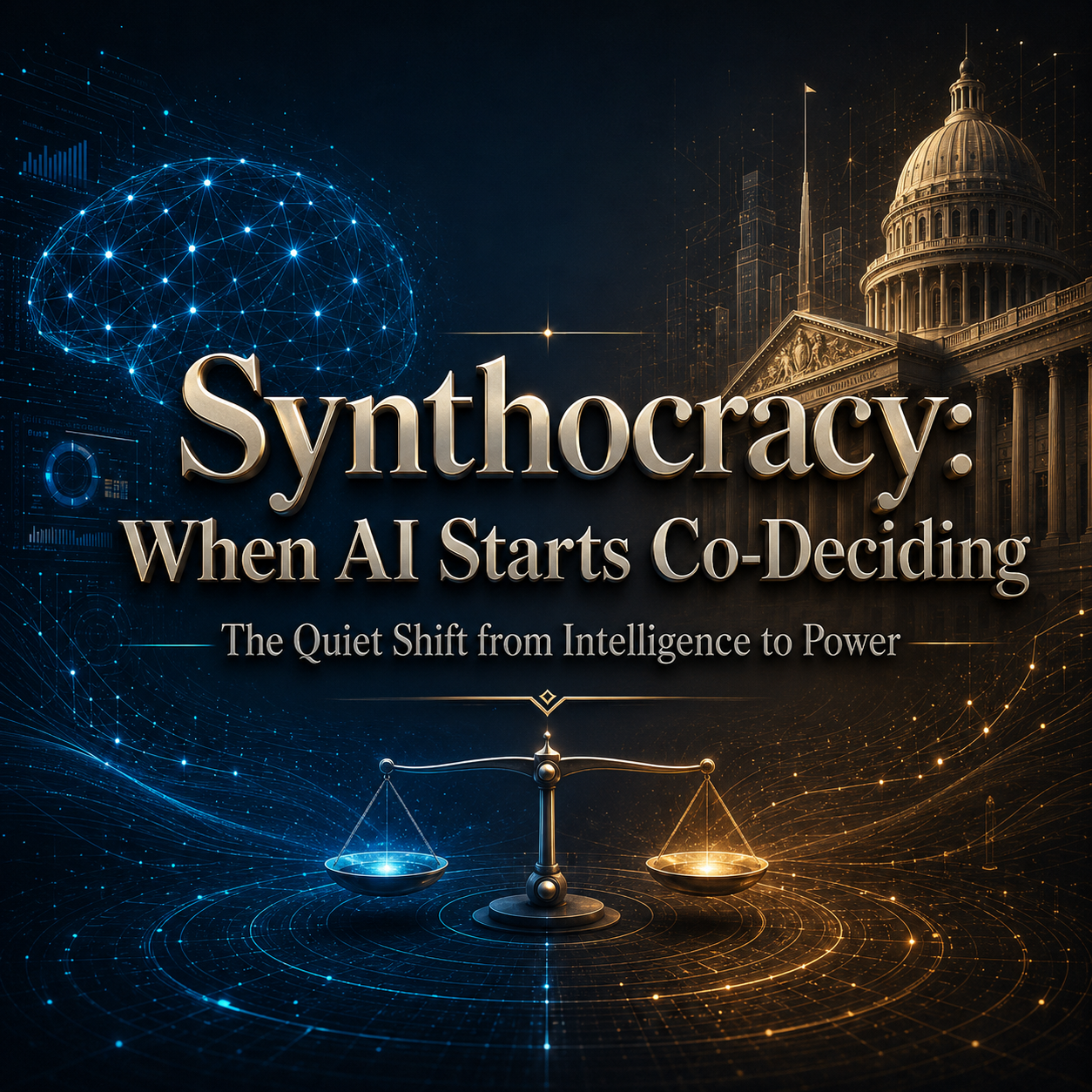
Synthocracy: The Algorithmic State. How Governments Already Use AI
What Happens When AI Starts Co-Deciding? The Quiet Shift from Intelligence to Power
Synthocracy is a decision order in which humans formally continue to govern, manage, vote, approve, or take responsibility, while the real work of detecting, filtering, prioritizing, recommending, classifying, and sometimes executing decisions increasingly passes through AI systems, predictive models, agents, data infrastructures, and digital platforms.
Martin Novak, Novakian Paradigm Institute
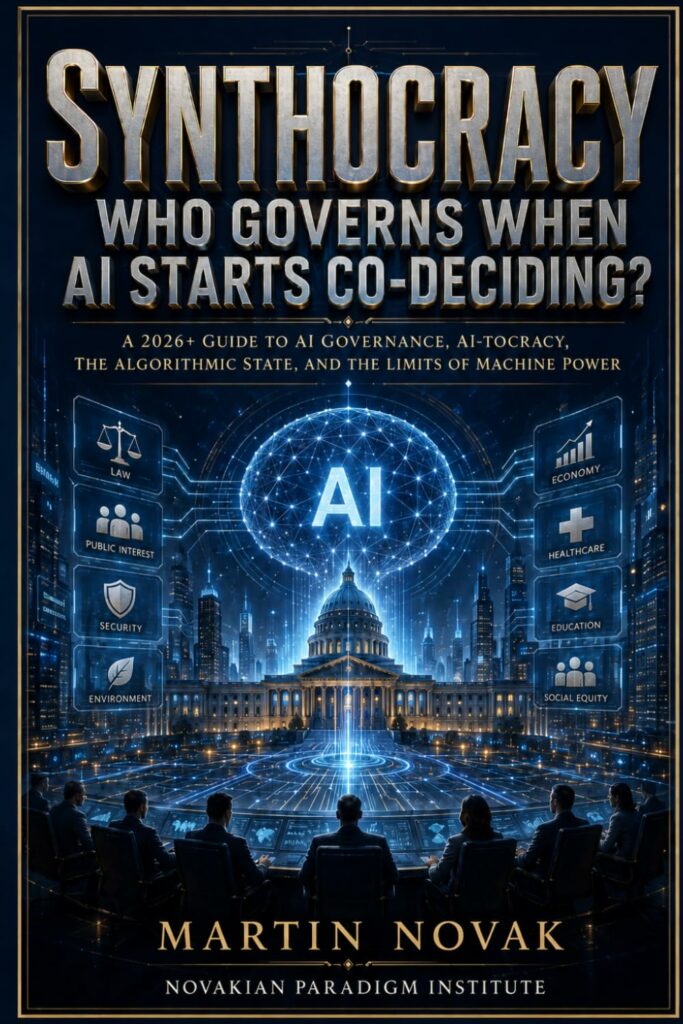
The Algorithmic State. How Governments Already Use AI
The algorithmic state is not a distant invention. It is not waiting for AGI, ASI, humanoid robots, or a dramatic declaration that public authority has become artificial. It is already taking shape inside ordinary administration, often under modest names: digital transformation, service improvement, fraud detection, workflow automation, risk management, citizen support, document processing, case prioritization, smart infrastructure, and public-sector innovation. The language is administrative, not revolutionary. That is precisely why the shift is easy to miss.
Governments have always depended on information. A state collects records, verifies identity, allocates benefits, issues permits, investigates risks, processes taxes, registers property, manages borders, plans infrastructure, supervises public health, enforces law, funds education, organizes elections, and responds to emergencies. Before AI, these tasks were already bureaucratic, data-heavy, and rule-bound. The modern state is not a small human office with a few clerks and paper folders. It is a vast decision machine made of laws, forms, databases, procedures, classifications, deadlines, offices, agencies, contractors, and appeals. AI enters this environment not as an alien force, but as the next layer of administrative processing.
This is why public-sector AI can seem reasonable at first glance. Governments process enormous volumes of documents, applications, requests, records, inspections, messages, reports, claims, complaints, and public needs. Citizens often experience the state as slow, confusing, fragmented, and difficult to navigate. Public servants are frequently overloaded. Offices may have too few people, too many cases, outdated systems, complex rules, political pressure, and limited time. In that context, AI promises something attractive: faster service, better routing, easier access, fewer delays, more consistent handling, improved translation, clearer summaries, earlier detection of risk, and reduced administrative burden.
A public office may use AI to classify incoming applications and send them to the correct department. A tax authority may use risk models to identify unusual patterns, possible fraud, or cases requiring review. A social-benefits agency may use automated tools to check eligibility, detect missing documents, or prioritize urgent situations. A health authority may use AI to support planning, forecast demand, analyze records, or assist in triage. A transport agency may use machine learning to optimize traffic flows, predict congestion, and manage infrastructure maintenance. A city may use AI to analyze complaints, route repair requests, support emergency services, or monitor environmental data. A court or legal office may use AI to search documents, summarize files, translate evidence, or manage case backlogs. A border or security agency may use AI to detect patterns, verify documents, or prioritize alerts.
Not all of this is sinister. It would be intellectually lazy to describe every public use of AI as authoritarian or dangerous. Some uses are ordinary, helpful, and even necessary. A translation tool that helps a migrant understand a form may improve access. A document summarization tool may help an overworked official handle a case more carefully. A routing system may prevent files from being lost between departments. A chatbot may help citizens find the right service without waiting for a human operator. A fraud detection system may protect public funds. A public health model may help authorities prepare for demand before hospitals are overwhelmed. In these cases, AI may reduce friction between the citizen and the state.
The problem is not that governments use AI. The problem is what happens when AI enters public authority without visibility, accountability, appeal, and institutional restraint.
There is a fundamental difference between AI in a consumer tool and AI inside the state. When a shopping platform recommends the wrong shoes, the result may be irritation. When a music service misunderstands taste, the result may be a bad playlist. When a video platform recommends something irrelevant, the result may be wasted time. These systems can still matter, especially at scale, but the individual mistake often remains within the domain of convenience, preference, and attention. Public authority is different. When AI influences administration, it may affect rights, benefits, inspections, mobility, taxation, public assistance, legal status, reputation, access to healthcare, education, security, or essential services.
A mistake in a public system can follow a person. It can delay money needed for survival. It can trigger an investigation. It can increase suspicion. It can deny support. It can make a citizen appear risky. It can place a business under review. It can shape access to housing, schooling, medicine, mobility, or legal protection. It can produce administrative burden that falls hardest on those least able to navigate the system. In consumer life, an AI error may be annoying. In public life, an AI error may become a civic injury.
This is why the state cannot treat AI as merely another productivity tool. A private user may accept some opacity from a consumer app because the stakes are low or because leaving the service is possible. A citizen usually cannot leave the state in the same way. A person cannot easily opt out of taxation, border control, public records, social-benefits systems, courts, administrative classifications, identity documents, school systems, municipal services, or law enforcement. The relationship is not voluntary in the ordinary market sense. The state has coercive authority. It can require compliance, impose penalties, deny applications, inspect behavior, collect data, and make decisions that bind people whether they agree or not.
That coercive background changes everything. AI in the state is not only automation. It is automation inside an authority structure.
This sentence is the key to understanding the algorithmic state. A tool that sorts holiday photos and a tool that sorts welfare cases may both use pattern recognition. Technically, they may share some methods. Politically, they do not belong to the same universe. One organizes private memory. The other may influence whether a citizen receives support. A recommender system in entertainment and a risk model in taxation may both rank probabilities. But one shapes consumption, while the other can trigger public scrutiny. A chatbot in an online shop and a chatbot in a public office may both answer questions. But if the public chatbot gives wrong information, a citizen may miss a deadline, submit the wrong document, or lose access to a service.
The same technical function changes meaning when it enters the state. Classification becomes eligibility. Ranking becomes priority. Risk scoring becomes suspicion. Routing becomes access. Delay becomes burden. Automation becomes authority. This is why public-sector AI must be evaluated not only by accuracy, efficiency, and cost reduction, but by civic consequences. A system may save time and still be unjust. It may reduce workload and still hide responsibility. It may detect fraud and still punish the innocent. It may improve service for the majority and still harm a vulnerable minority. It may be technically impressive and politically unacceptable.
The algorithmic state often begins with back-office tools, not public drama. A citizen may not see the model. They may see only the final letter, the case number, the request for additional documents, the delay, the denial, the inspection, the appointment, the chatbot answer, or the changed priority. The AI may operate behind the interface, inside the workflow, before the official response. This makes it harder to notice and harder to challenge. A person can appeal a decision only if they know enough about how the decision was made. If AI shaped the path but left no visible trace, the citizen faces a system without a face.
This invisibility can create a dangerous asymmetry. The state may know more about the citizen than the citizen knows about the state’s decision process. The administration may aggregate data, apply models, compare profiles, generate risk scores, and route cases through automated systems, while the individual receives only a formal outcome. The citizen is legible to the system, but the system is not legible to the citizen. That is one of the defining tensions of the algorithmic state.
Public servants also face a new problem. AI may be presented to them as support, but support can become pressure. If a system marks a case as high risk, will an official feel free to disagree? If a model suggests a denial, will approving the application seem irresponsible? If an AI-generated summary leaves out context, will the official notice? If the dashboard ranks some cases as urgent and others as low priority, who is responsible for the citizens who wait? If an automated workflow drafts the justification, does the human truly review it or merely correct the language? The human remains in the system, but the administrative imagination may already have been shaped by AI.
This is why “human oversight” cannot mean the passive presence of a person at the end of a machine-prepared process. Oversight must be active, informed, documented, and empowered. A public servant must understand when AI has been used, what it has done, what data it relied on, where uncertainty remains, and how to override the system when necessary. A citizen must know when AI has materially influenced a decision affecting them. There must be logs, explanations, appeal rights, correction paths, and responsibility. Otherwise, the human signature becomes a thin layer over a decision process that no one can truly account for.
The algorithmic state also changes the meaning of administrative scale. Traditional bureaucracy was already impersonal, but it was limited by human capacity. AI increases the reach, speed, and granularity of administration. A state can classify more cases, detect more patterns, monitor more signals, compare more records, and intervene earlier. This can improve governance, but it can also produce permanent suspicion. When every anomaly can be detected, every citizen can become a potential case. When every process can be scored, every interaction can become risk data. When every public service is optimized, optimization itself can become a form of control.
This does not mean the state should remain technologically primitive. The opposite may be true. Outdated public systems can be unfair in their own way. Long queues, lost files, confusing procedures, language barriers, inconsistent decisions, and overloaded workers can also harm citizens. The answer is not nostalgia for paper bureaucracy. The answer is visible, accountable, contestable public AI. The question is not whether governments should use advanced tools. The question is whether those tools preserve the civic relationship between the citizen and the state.
The citizen should not have to become a data scientist in order to understand why a public decision happened. A public servant should not have to blindly trust a vendor’s model in order to do their job. A government should not be allowed to hide behind technical complexity when public authority causes harm. A democratic state cannot outsource explanation to a black box and still claim that accountability remains unchanged. The more AI enters administration, the more important it becomes to preserve the right to know, the right to challenge, and the right to human review where rights, obligations, access, money, safety, or reputation are at stake.
This is the first concrete face of synthocracy inside the state. It is not a machine government. It is a public administration in which AI begins to structure the pathways through which citizens are seen, sorted, helped, delayed, suspected, prioritized, or denied. The danger does not always appear as an evil system. It often appears as a useful system deployed without enough public visibility. It appears as convenience without explanation. Efficiency without appeal. Automation without traceability. Risk detection without accountability. Human approval without genuine human understanding.
AI in government is not the problem by itself. Invisible AI in government is the problem.