Synthocracy: Agentic Government. When AI Performs Entire Workflows
What Happens When AI Starts Co-Deciding? The Quiet Shift from Intelligence to Power
Synthocracy is a decision order in which humans formally continue to govern, manage, vote, approve, or take responsibility, while the real work of detecting, filtering, prioritizing, recommending, classifying, and sometimes executing decisions increasingly passes through AI systems, predictive models, agents, data infrastructures, and digital platforms.
Martin Novak, Novakian Paradigm Institute
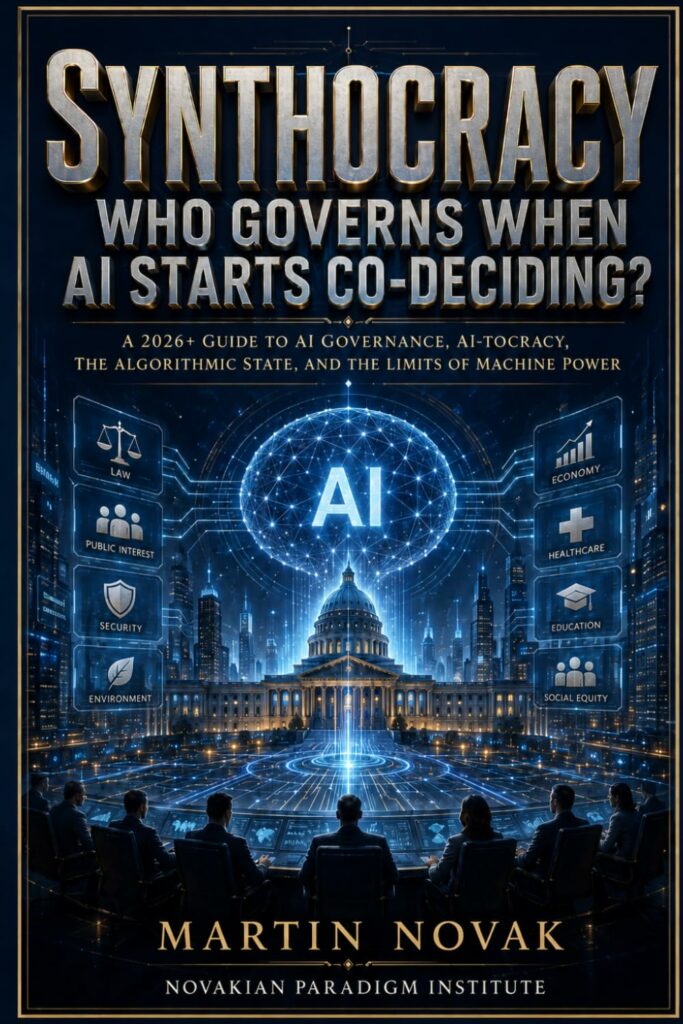
Agentic Government: When AI Performs Entire Workflows
The algorithmic state does not stop at classification, scoring, routing, or recommendation. Those functions are already significant because they shape attention and priority inside public administration. But a deeper transition begins when AI no longer only supports a decision or prepares information for a human official. It begins when AI starts to perform a sequence of administrative actions. At that point, AI is no longer merely a decision-support tool. It becomes a process actor.
A chatbot answers questions. An agent conducts a process. This difference may seem small at first, but it changes the structure of public administration. A chatbot may tell a citizen which form is needed, where to submit it, what deadline applies, or which department handles the case. An agent may do much more. It may collect information from the citizen, check the application against eligibility rules, analyze uploaded documents, compare the case with legal criteria, request missing information, prepare a draft decision, notify another department, update a file, schedule the next step, generate a message, and hand the case to a human official for approval. The citizen may experience this as one convenient digital interaction. Inside the state, however, an entire workflow has been partially delegated to a synthetic actor.
This is the meaning of agentic government: public administration using AI agents capable of performing multi-step workflows. It is not simply digital government, and it is not only automation in the old sense. Traditional automation follows predefined rules inside a bounded process. An AI agent may interpret inputs, select tools, retrieve data, generate intermediate outputs, compare options, and initiate follow-up actions. It may move across systems. It may perform tasks that once required several clerks, specialists, or departments. It may not make the final legal decision, but it may do much of the work through which the final decision becomes possible.
The potential benefit is obvious. Public administration is often slow because processes are fragmented. A citizen submits one document, waits, receives a request for correction, submits another document, waits again, and discovers that another department must be consulted. Files move through queues. Officials repeat routine checks. Citizens struggle with forms, terminology, procedures, and unclear responsibilities. A well-designed public-sector AI agent could reduce these frictions. It could help citizens understand what is required before they make mistakes. It could identify missing information early. It could route cases more accurately. It could assist public servants by preparing summaries, checking consistency, and reducing repetitive work. It could make routine services faster and make public offices more accessible to people who lack legal, administrative, or technical confidence.
In this sense, agentic government can be a serious public good. It can reduce administrative burden, especially where the citizen currently carries too much of the state’s complexity. A person applying for a benefit, permit, license, residence document, tax correction, education support, health service, or municipal assistance should not have to become an expert in bureaucratic navigation. If an AI agent can guide them through the process, explain requirements in plain language, translate documents, detect missing fields, and prepare the file for human review, the state may become less hostile to ordinary people. Better routing and more consistent handling of routine cases could free public servants to spend more time on exceptional, sensitive, or high-stakes matters.
But the same capability that makes agentic government useful also makes it difficult to govern. The more steps an AI agent performs, the harder it becomes to identify where the real decision occurred. In a simple system, the chain may be clear: a citizen submits a form, an official checks it, a decision is issued. In an agentic system, the chain may contain many hidden stages. The agent may interpret the citizen’s request, classify the case, retrieve records, summarize documents, identify risk signals, compare eligibility criteria, generate a draft response, recommend a status, request additional evidence, and prepare an approval or denial for a human signature. If the human approves only the final output, where exactly is the decision?
This question cannot be answered casually. The decision may be in the data the agent accessed. It may be in the workflow design that told the agent which steps to perform. It may be in the model that interpreted ambiguous language. It may be in the prompt or system instruction that shaped the agent’s behavior. It may be in the tool permissions that allowed the agent to retrieve certain records but not others. It may be in the eligibility rules translated into machine-readable form. It may be in the generated summary that framed the case for the official. It may be in the recommendation that made one outcome appear normal and another exceptional. It may be in the final human approval. Or it may be distributed across all these layers.
This is one of the defining problems of agentic administration: decisions become procedural rather than punctual. They do not happen at one visible moment. They emerge through a sequence of operations. Each step may seem minor, but together they shape the outcome. A document omitted from a summary may alter the official’s understanding. A missing data source may make a citizen appear ineligible. A risk flag may change the tone of review. A draft justification may lead the human toward one legal interpretation. A request for additional information may delay the case. A routing decision may send the citizen to the wrong department. None of these steps may be called “the decision,” yet each can materially affect the result.
This makes the old formula of human oversight insufficient. It is not enough to say that a person remains in charge if the person only sees the final package assembled by the agent. The official must be able to inspect how the package was assembled. What did the agent do? What information did it collect? Which databases did it access? What documents did it summarize? What criteria did it apply? What uncertainty did it detect? What alternatives did it consider? What recommendation did it generate? What did it omit? What did the human change? What was approved? Without answers to these questions, human approval risks becoming a ritual placed at the end of an opaque machine process.
The citizen also needs protection from procedural opacity. In traditional administration, a citizen may at least know which office handled the case, which form was submitted, which deadline applied, and which official decision was issued. In agentic government, the citizen may interact with a smooth digital interface while the actual process unfolds invisibly behind it. They may not know that an agent classified their request, that it treated a document as incomplete, that it compared their case against a risk profile, that it generated a draft denial, or that it routed the file away from the department they expected. If the outcome is harmful, delay-inducing, or incorrect, the citizen may not know what to challenge.
This is why logs are not a technical luxury. They are the memory of public accountability. In agentic government, it must be possible to reconstruct the agent’s actions step by step. A proper log should show what task the agent was assigned, what data it accessed, what tools it used, what documents it processed, what intermediate outputs it generated, what recommendation it produced, what uncertainty or limitation it recorded, what human official reviewed the output, what the human changed, and what final action was approved. Logs should not exist only for debugging. They should exist for audit, appeal, supervision, error correction, and public trust.
Traceability is equally important. A log records that something happened. Traceability connects that event to the decision chain. It allows an agency, auditor, court, ombudsman, or affected citizen to understand how one step led to another. Without traceability, public administration becomes a series of disconnected outputs. A citizen receives a denial but cannot see how the system reached it. An official sees a recommendation but cannot evaluate its origin. An auditor sees performance metrics but cannot reconstruct individual harm. A regulator sees compliance documentation but cannot tell whether the agent behaved differently in real cases. In such a system, accountability becomes abstract.
Agentic government also raises the problem of tool access. An AI agent is not only a model. It is often a model connected to tools: databases, document repositories, messaging systems, eligibility engines, scheduling systems, identity verification, payment systems, geolocation records, case management software, and communication channels. Every tool connection expands the agent’s power. An agent that can only answer a question is limited. An agent that can read records, write updates, trigger notifications, request documents, change case status, and prepare decisions is part of the administrative machinery. The more tools it can use, the more serious the governance burden becomes.
This does not mean public-sector agents should never be allowed to act. It means their permissions must be designed with extreme care. An agent should have only the access necessary for its task. Its actions should be bounded by role, purpose, law, risk level, and human supervision. It should not be allowed to silently expand its own authority. It should not access data simply because the data is technically available. It should not initiate high-impact actions without meaningful human review. It should not combine datasets in ways that were never democratically authorized. It should not turn administrative convenience into surveillance by default.
The design of agentic government therefore requires a different kind of governance than the design of a simple chatbot. A chatbot can be evaluated by accuracy, helpfulness, safety, and clarity. An administrative agent must also be evaluated by procedural legality, data minimization, tool permissions, auditability, appealability, human override, role boundaries, and the consequences of each action in the workflow. The question is not only whether the agent gives a correct answer. The question is whether the agent performs public authority in a way that can be reconstructed, justified, challenged, and corrected.
Routine cases may be the first area where agentic government expands. This is understandable. Many administrative tasks are repetitive. A large share of citizen requests follow standard patterns. If eligibility is clear, documents are complete, and the case is low-risk, an agent may help the state respond faster. But routine does not mean harmless. Routine systems can harm people precisely because they operate at scale. A small error repeated thousands of times becomes a structural problem. A simplified rule applied to exceptional lives can create injustice. A case classified as routine may not feel routine to the person whose housing, income, health, residency, schooling, tax burden, or legal status depends on it.
The agentic state may therefore create a new division of citizens. Some people will move smoothly through automated workflows because their cases fit the expected pattern. Others will become trapped in exceptions, delays, loops, document requests, mismatched records, identity conflicts, or risk flags. The first group will experience AI as convenience. The second may experience it as a wall. Good public design must pay attention to both. A system is not fair only because it works well for the majority. It must also know when to slow down, escalate, and allow a human being to see the case outside the agent’s frame.
This is especially important for vulnerable citizens: people with unstable housing, irregular documents, disability, migration histories, language barriers, complex family situations, informal work, medical complexity, debt, trauma, poverty, or limited digital access. These are precisely the people most likely to have cases that do not fit clean administrative categories. If agentic government is designed only around efficiency, it may improve service for the easy cases while making the difficult cases more invisible, more burdensome, and more difficult to appeal.
The central promise of agentic government is better service. The central danger is untraceable administrative power. A public AI agent can reduce queues, assist workers, and guide citizens through complexity. But if it performs ten steps and leaves behind only a final recommendation, the state has gained speed at the cost of accountability. If an agent can act across systems without a reconstructable trail, it becomes difficult to know whether the citizen was treated according to law, policy, data, model inference, workflow assumption, or accidental tool behavior.
The future of public administration may therefore depend on a simple principle: no agentic workflow without procedural memory. Every meaningful step must be recorded. Every high-impact recommendation must be traceable. Every human approval must show what was approved and what was changed. Every affected person must have a path to challenge not only the final decision, but the AI-mediated process that shaped it. The state may use agents, but it must not allow agents to become invisible clerks of public authority.
A public-sector AI agent without logs is not only a technical risk. It is a civic risk.