Synthocracy: The Citizen Facing a System They Cannot See
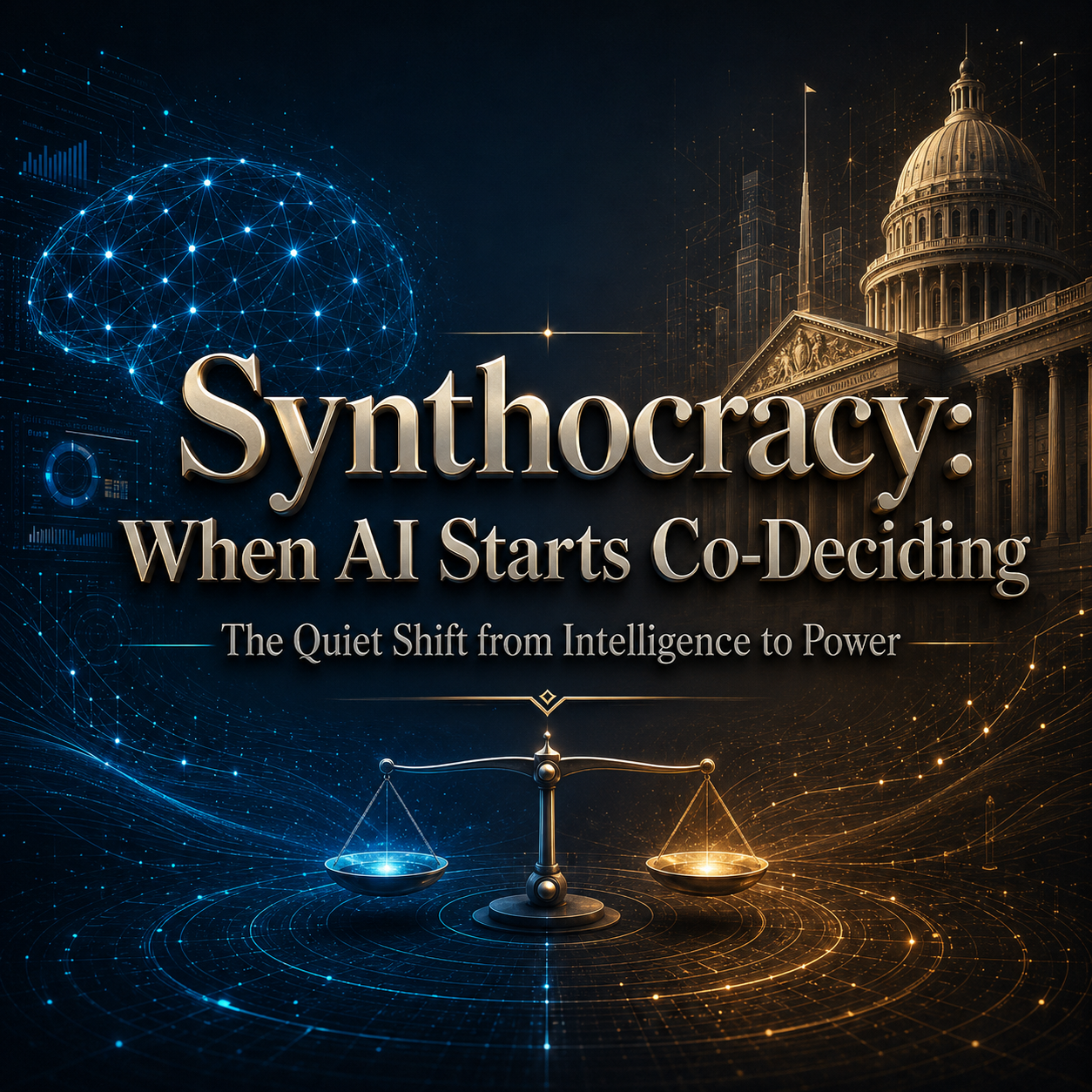
What Happens When AI Starts Co-Deciding? The Quiet Shift from Intelligence to Power
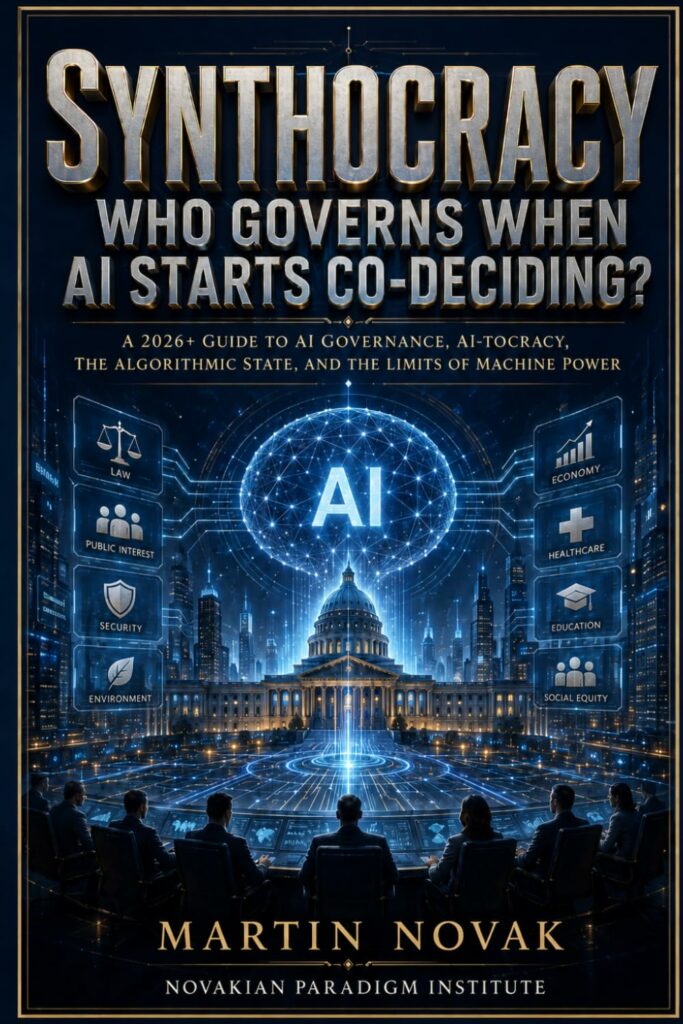
Synthocracy is a decision order in which humans formally continue to govern, manage, vote, approve, or take responsibility, while the real work of detecting, filtering, prioritizing, recommending, classifying, and sometimes executing decisions increasingly passes through AI systems, predictive models, agents, data infrastructures, and digital platforms.
Martin Novak, Novakian Paradigm Institute
The Citizen Facing a System They Cannot See
The deepest problem of the algorithmic state is not that citizens dislike technology. Most people already live with digital systems. They use online banking, navigation apps, search engines, messaging platforms, recommendation systems, identity verification, e-commerce, digital maps, electronic forms, and automated notifications. Many citizens want public administration to become faster, clearer, and more accessible. They do not necessarily want paper, queues, repeated visits, lost documents, unclear instructions, and offices that operate as if citizens had unlimited time. The problem is not technology itself. The problem begins when a citizen is governed by a system they cannot see.
A citizen receives a denial but does not know that an AI risk model influenced the decision. A citizen is selected for review but does not know that an algorithm flagged their case. A citizen waits longer but does not know that an automated system assigned a lower priority. A citizen is asked for additional documents but does not know that a document classifier marked the file as incomplete. A citizen is told to appeal through a form but cannot understand what must actually be challenged. The official letter may look ordinary. The process may appear bureaucratic in the familiar way. Yet somewhere upstream, a synthetic layer may have shaped the result.
This is the human face of the algorithmic state: not a robot issuing commands, but a person trying to understand why the state has acted as it has acted. The harm may not feel futuristic. It may feel like silence, delay, suspicion, rejection, repetition, or administrative exhaustion. The citizen calls an office and receives no clear answer. They submit a correction and the system still behaves as if the old data were true. They ask why they were selected for review and receive a generic explanation. They appeal the decision, but the appeal form does not reveal the model, data, or classification that mattered. They are told a human made the decision, yet the human seems unable to explain the path by which the decision became likely.
Traditional administration is often frustrating, but it is at least imaginable. A citizen can picture a desk, a file, a clerk, a rule, a supervisor, an office, a stamped decision, and an appeal route. That image may be incomplete, but it gives the citizen a basic civic grammar. Who made this decision? Under what rule? Which document was missing? Which office should I contact? Where do I appeal? Who signs the answer? Who is responsible? In the algorithmic state, these questions can become harder. The decision may have been shaped by data from another agency, a vendor’s system, a scoring model, a routing engine, an AI-generated summary, a workflow rule, a risk flag, or an automated priority setting. The citizen sees the final surface but not the machinery behind it.
This creates a new kind of powerlessness. It is not only the powerlessness of losing a case. It is the powerlessness of not knowing what the case is. A citizen cannot challenge what they cannot identify. They cannot correct data they cannot see. They cannot contest a score they are not told exists. They cannot rebut a risk category that is never named. They cannot request meaningful human review if the human reviewer only sees the same AI-shaped file. They cannot hold an institution accountable if responsibility is distributed across an agency, a software vendor, a model provider, a data source, a workflow designer, and a final official signature.
The result is invisible procedure. The citizen is not governed by one visible person, but by a chain of operations. One system collects data. Another system links it. Another system classifies the case. Another system assigns priority. Another system generates a summary. Another system recommends action. A human official approves the result. A standard letter is sent. Each part may appear small. Each actor may say that it did not make the final decision. Yet the combined process has produced a binding administrative reality. The citizen must now respond to that reality without being allowed to see the process that created it.
This is where the algorithmic state can become more difficult to answer than the paper state. Paper bureaucracy can be slow, unfair, rigid, and opaque in its own way. It should not be romanticized. But paper leaves traces that are often easier to understand: a form, a note, a rule, a missing signature, a date, a file path, a person responsible for the case. Digital and AI-mediated systems may leave traces too, but those traces are not automatically available to the citizen. They may exist only in logs, databases, dashboards, model outputs, vendor systems, or internal audit tools. If the citizen cannot access the essential explanation, the trace does not function as civic accountability.
The first minimum right in an AI-influenced administrative process is the right to know that AI was used. This does not mean that every minor spell-checking tool, translation aid, or internal search function must produce a dramatic warning. But when AI materially influences classification, priority, eligibility, risk assessment, routing, recommendation, fraud detection, draft justification, or final outcome, the affected person should be told. A citizen should not have to guess whether the state used AI in a process that affected their rights, obligations, access, money, safety, or reputation. Hidden AI participation creates hidden power.
The second minimum right is the right to understand the essential reasons. The citizen does not need a technical lecture on model architecture. They do not need every parameter, training detail, or line of code. But they do need a meaningful explanation of why the decision happened. Which facts mattered? Which criteria were applied? Was the case flagged as high risk, incomplete, low priority, ineligible, inconsistent, or unusual? What data categories contributed to that assessment? What uncertainty remained? Which rule or policy connected the system’s output to the administrative result? An explanation that says only “the system processed your case” is not an explanation. It is a refusal in technical language.
The third minimum right is the right to human review. But human review must mean more than a person looking at a screen after the machine has framed the answer. A genuine human review requires authority, time, context, and independence from the system’s default. The reviewer must be able to see the AI’s role, examine the underlying information, consider new evidence, correct errors, and depart from the recommendation without being punished by the workflow. If human review merely confirms the machine-generated path, it becomes ceremonial. The citizen does not need a human rubber stamp. The citizen needs a human capable of seeing beyond the synthetic frame.
The fourth minimum right is the right to correct data. In an algorithmic state, inaccurate data can become a persistent shadow. A wrong address, mistaken identity match, outdated income record, old debt, incorrect benefit history, misread document, false fraud signal, or incomplete medical code may shape several future processes. If the citizen cannot find and correct the error, the same mistake may repeat across agencies and systems. The right to correct data is therefore not only a privacy right. It is a procedural right, a fairness right, and in some cases a survival right. Public administration must not make citizens live under administrative ghosts they cannot exorcise.
The fifth minimum right is the right to appeal. Appeal must be meaningful, not decorative. It is not enough to provide a form if the citizen does not know what to contest. It is not enough to offer a deadline if the explanation is too vague to answer. It is not enough to say that a human will review the case if the review does not include the AI-mediated steps that shaped the outcome. A meaningful appeal must allow the citizen to challenge the facts, the data, the interpretation, the classification, the priority, the recommendation, and the final decision where relevant. It must also allow correction of the process, not only correction of the result.
The sixth minimum right is the right to know who is responsible. This may be the most politically important right of all. AI can blur responsibility because many actors participate in the chain. The agency may blame the vendor. The vendor may blame the data. The data provider may blame the source agency. The model provider may say the system was only advisory. The official may say they followed the workflow. The workflow designer may say the final decision remained human. The citizen cannot be expected to resolve this chain. Public authority must have a named responsible body. If the state uses AI, the state remains answerable.
These rights are not anti-technology. They are pro-citizen. They do not prevent governments from using AI. They define the civic conditions under which AI can be used without turning administration into invisible power. A citizen who knows AI was used, understands the essential reasons, can request human review, can correct data, can appeal, and knows who is responsible is not helpless before the machine. They may still lose the case. The decision may still be lawful. The AI-assisted process may still be justified. But the citizen remains a participant in a public order, not merely an object processed by an unseen system.
This distinction is essential. The state does not only deliver services. It also defines the relationship between person and authority. When administration becomes AI-mediated, the citizen must not be reduced to a data profile moving through automated channels. The citizen remains a rights-bearing person. Public power owes that person reasons. It owes a path to challenge. It owes correction when data is wrong. It owes accountability when systems cause harm. It owes visibility when artificial systems participate in decisions that matter.
A state using AI must therefore become more careful, not less answerable. It must not hide behind complexity. It must not treat efficiency as an excuse for opacity. It must not preserve the appearance of human decision-making while moving the decisive steps into systems citizens cannot inspect. It must not say “the computer assisted” as if assistance were politically neutral. It must not allow vendor contracts, model secrecy, security language, or administrative convenience to dissolve the citizen’s right to understand public power.
The algorithmic state will be judged not only by how fast it processes cases, but by how answerable it remains when citizens ask why. A faster state that cannot explain itself is not a better state. A more efficient office that cannot be challenged is not a more legitimate office. A digital administration that leaves citizens facing invisible procedure has not modernized public power. It has made power harder to reach.
A state using AI must not become less answerable than a state using paper.