
Synthocracy: The Three Faces of Synthocracy
What Happens When AI Starts Co-Deciding? The Quiet Shift from Intelligence to Power
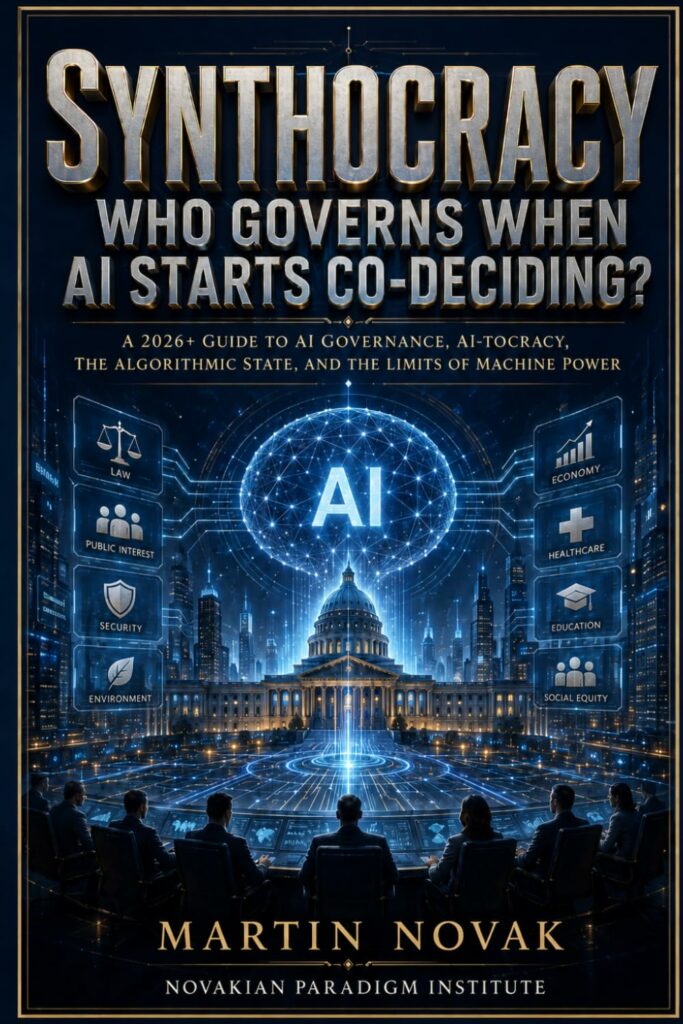
Synthocracy is a decision order in which humans formally continue to govern, manage, vote, approve, or take responsibility, while the real work of detecting, filtering, prioritizing, recommending, classifying, and sometimes executing decisions increasingly passes through AI systems, predictive models, agents, data infrastructures, and digital platforms.
Martin Novak, Novakian Paradigm Institute
The Three Faces of Synthocracy
Synthocracy is not one destiny. It is a field of possible directions. Once AI begins to participate in decision systems, the future does not move automatically toward one fixed regime. The same underlying capability — the ability to detect, classify, predict, recommend, route, summarize, and act — can be attached to very different institutional purposes. It can strengthen surveillance or improve service. It can centralize control or widen participation. It can support public deliberation or manipulate attention. It can make administration more answerable or more opaque. It can distribute knowledge or concentrate power inside private infrastructures that no citizen voted for and few institutions can fully inspect.
This is why the next part of the book does not ask whether synthocracy is simply good or bad. That question is too crude. A more useful question is: in which direction is the system moving? The same technical vocabulary may appear in very different political forms. Prediction can help prevent floods, disease outbreaks, infrastructure failures, and fraud. Prediction can also create suspicion before action. Automation can reduce administrative burden. Automation can also remove human judgment from cases where context matters. AI-assisted consultation can help citizens understand policy and find common ground. AI-assisted manipulation can flood the public sphere with synthetic persuasion. Platform governance can reduce harmful content and fraud. Platform governance can also become private rule over visibility, commerce, speech, and reputation.
Part II presents three faces of synthocracy. The first is the dark variant: AI-tocracy. This is the form in which AI strengthens surveillance, prediction, automated control, repression, manipulation, and authoritarian capacity. It does not always begin with open dictatorship. It may begin with security dashboards, risk scores, public-order analytics, fraud detection, behavioral monitoring, and automated escalation. Its danger is not only that the state sees more. Its danger is that the state may begin to treat predicted behavior as a reason for intervention before a person has acted.
The second face is the democratic possibility: synthetically assisted democracy. Here AI is not used to replace citizens, but to support deliberation, consultation, participation, collective intelligence, and public understanding. In this direction, AI may help people navigate complex policy questions, summarize competing arguments, find areas of agreement, translate technical language, process large-scale public feedback, and make democratic participation less dependent on time, education, status, or proximity to institutions. But this possibility carries its own risk: whoever designs the questions, selects the data, sets the frame, and summarizes the results may shape the democratic process itself.
The third face is private power. This may become the most underestimated face of synthocracy because it does not look like government. Platforms, frontier model labs, cloud providers, chip suppliers, data infrastructures, compliance vendors, recruitment tools, scoring engines, marketplaces, payment systems, and content distribution systems increasingly shape the conditions under which public and economic life operates. These actors may not pass laws, but they can define access. They may not hold elections, but they can structure visibility. They may not call themselves regulators, but they can decide what is allowed, ranked, trusted, monetized, blocked, or escalated. In an AI-mediated society, private infrastructure can become quasi-public authority.
The purpose of this part is not to predict which face will dominate. It is to teach the reader how to recognize the direction in which a system is moving. A synthocratic system should be judged by its structure, not only by its slogan. Does it make people more visible to power while making power less visible to people? Does it allow appeal, audit, explanation, and human review? Does it use AI to widen participation or narrow control? Does it concentrate decision infrastructure in a few private hands? Does it treat citizens as partners in governance or as risk profiles to be managed? Does it preserve legitimacy, or does it hide behind capability?
The three faces are not mutually exclusive. A state may use AI to improve services and expand surveillance at the same time. A platform may support public knowledge while manipulating attention for profit. A democratic government may rely on private infrastructure that limits its sovereignty. A compliance system may protect rights in one context and normalize opaque decision-making in another. Synthocracy is not a single machine with one moral direction. It is a decision order made of incentives, institutions, data flows, model access, legal constraints, business models, public expectations, and emergency language.
This is why recognition matters. By the time a system is openly abusive, many of its foundations may already be in place. By the time citizens notice that decisions have become difficult to challenge, the logs may already be missing. By the time public authorities become dependent on private AI infrastructure, alternatives may already be too expensive to build. By the time surveillance is justified as normal risk management, the social habit of being permanently visible may already have settled. The point of this part is to see earlier.