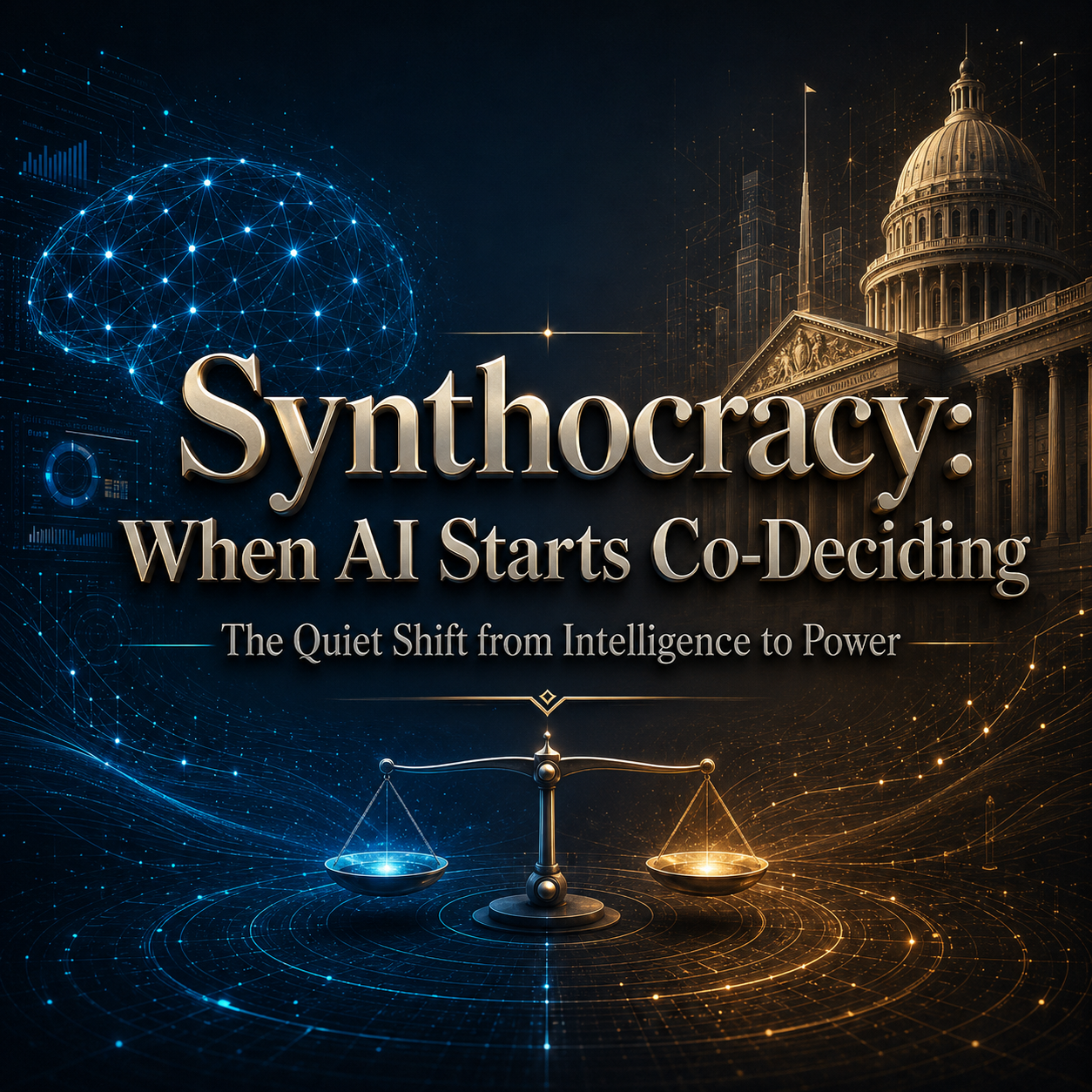
Synthocracy: AI-tocracy. The Dark Twin of Synthocracy. Prediction, Surveillance, and Automated Control
What Happens When AI Starts Co-Deciding? The Quiet Shift from Intelligence to Power
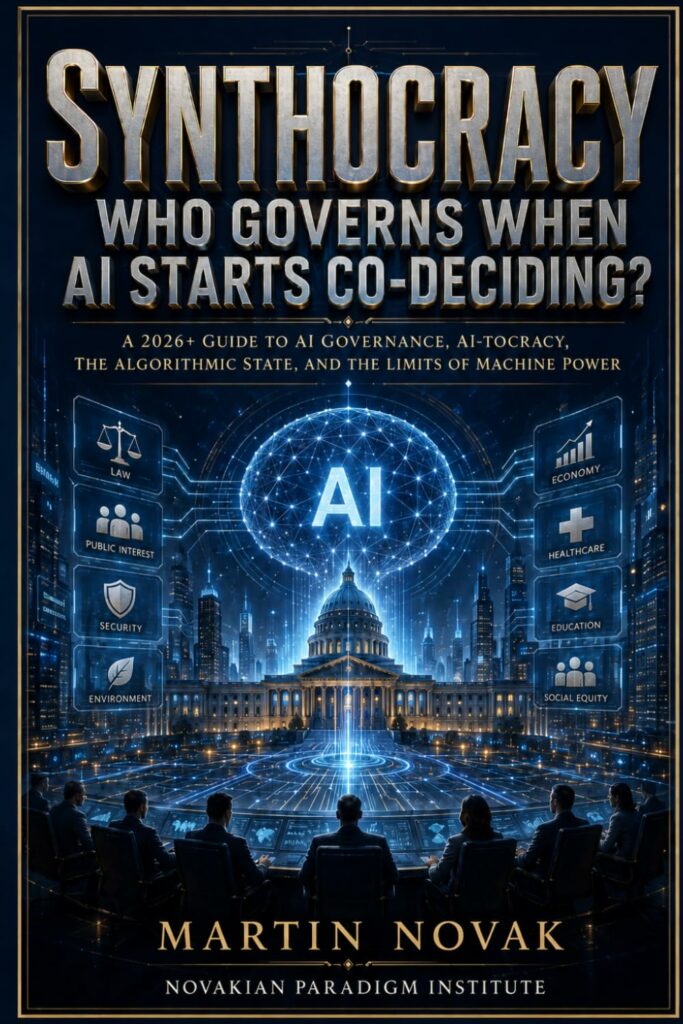
Synthocracy is a decision order in which humans formally continue to govern, manage, vote, approve, or take responsibility, while the real work of detecting, filtering, prioritizing, recommending, classifying, and sometimes executing decisions increasingly passes through AI systems, predictive models, agents, data infrastructures, and digital platforms.
Martin Novak, Novakian Paradigm Institute
AI-tocracy: The Dark Twin of Synthocracy. Prediction, Surveillance, and Automated Control
The darkest form of synthocracy does not begin with robots in the streets. It does not require machines with weapons, metallic police, visible command centers, or an openly declared end of human politics. Those images distract from the more realistic path. AI-tocracy begins when prediction, surveillance, and automated response are fused into a governing system. It begins when power not only observes what people do, but estimates what they may do next; when data collection expands from events to patterns; and when the system can trigger consequences before human judgment has fully entered the scene.
Prediction is the first element. In ordinary language, prediction sounds neutral. Governments and institutions predict many things for legitimate reasons. They predict floods, droughts, disease outbreaks, traffic congestion, energy demand, tax fraud, infrastructure risk, hospital capacity, supply shortages, public-safety needs, and emergency response patterns. Without prediction, modern administration would be blind. A responsible state should prepare for risks before harm becomes irreversible. A city that can predict traffic bottlenecks may reduce accidents and pollution. A public health agency that can detect outbreak signals early may save lives. A tax authority that identifies suspicious patterns may protect public funds. Prediction, by itself, is not the enemy.
But prediction changes character when it becomes suspicion before action. The political risk begins when a person, group, district, movement, transaction, message, journey, purchase, association, or behavior is treated not only according to what has happened, but according to what a system estimates might happen. A person is no longer judged only by acts, evidence, and context. They are increasingly approached through probability. They may be flagged as risky, non-compliant, unstable, fraudulent, extremist, disruptive, unreliable, or undesirable before any human has seriously examined the case. The future enters the present as a reason for intervention.
Surveillance is the second element. Prediction requires data, and large-scale prediction requires large-scale visibility. The more a state or organization wants to predict, the more it wants to collect. It may collect administrative records, financial data, location data, communication metadata, social media activity, biometric identifiers, travel patterns, purchase behavior, employment history, educational records, health indicators, tax information, platform behavior, device signals, public-camera footage, and network connections. Each dataset may be justified separately. One is collected for security. Another for fraud prevention. Another for service improvement. Another for urban planning. Another for compliance. Another for identity verification. But when combined, these datasets can form a map of civic life.
Surveillance does not always feel like surveillance at the beginning. It may feel like convenience, personalization, faster processing, safer streets, smarter cities, better fraud control, smoother mobility, or more efficient public services. The citizen taps a card, scans a document, registers a device, logs into a portal, uses a public service, moves through a station, applies for support, pays taxes, posts online, or interacts with a platform. Each action creates data. Over time, the state or an organization may not need to follow the person physically. The person’s traces become enough.
Automated control is the third element. Prediction and surveillance become politically dangerous when they are connected to action. The system does not merely observe. It triggers. It flags a case for review. It blocks a transaction. It escalates a file. It restricts access. It lowers ranking. It increases inspection probability. It delays an application. It sends an alert. It denies a benefit. It withholds visibility. It recommends intervention. It generates a warning. It routes a person into a more suspicious category. It creates friction. In the softest form, automated control may not look like punishment. It may look like additional verification, longer waiting, reduced reach, extra documents, a risk label, or a lower priority. But these frictions can become a system of governance.
The fusion of these three elements creates the AI-tocratic pattern. Prediction estimates future risk. Surveillance supplies the continuous data stream. Automated control translates the estimate into institutional action. A person does not need to be convicted, proven dangerous, or publicly accused. It may be enough to be statistically associated with a pattern. A neighborhood does not need to erupt. It may be enough to be predicted as unstable. A protest does not need to become violent. It may be enough to be classified as a potential disorder event. A citizen does not need to commit fraud. It may be enough for the system to mark the file as suspicious.
This is where the language of risk can become the language of pre-emptive power. Modern states and organizations are risk-sensitive, and for understandable reasons. They must prevent terrorism, fraud, organized crime, cyberattacks, public disorder, disease outbreaks, financial instability, and infrastructure failure. But risk is elastic. Once a system is built to detect risk, there is always pressure to widen the category. More data promises more safety. More prediction promises earlier intervention. More automation promises faster response. More integration promises a fuller picture. The danger is that prevention becomes permanent suspicion.
AI-tocracy therefore does not require the abolition of law. It may operate beside law, around law, or before law. Formal legal decisions may still exist, but much of the practical control can happen earlier. A person may be made visible to authorities before any legal case begins. A group may be monitored before any crime occurs. A message may be suppressed before any court evaluates it. A financial transaction may be blocked before any human investigation. A traveler may be delayed before any accusation. A citizen may be repeatedly asked for documents because a model treats their profile as anomalous. The system does not always punish directly. It changes the conditions under which a person moves through society.
In such a system, the most important question is not only “Was the decision legal?” but “What happened before the decision became visible?” Who was watched? Who was scored? Who was categorized? Who was treated as risky? Who was escalated? Who was silently deprioritized? Which data sources were combined? Which historical patterns were used? Which groups became over-visible? Which behaviors were interpreted as signals of threat? Which actions were triggered automatically? Which humans were allowed to question the system’s output? Which citizens were told that the system had acted on them?
AI-tocracy can grow in authoritarian states, but the pattern is not limited to them. Democratic societies can also develop AI-tocratic mechanisms if emergency language, security incentives, institutional secrecy, and technical opacity combine. A democracy may say that surveillance is temporary, targeted, proportionate, and necessary. It may say that predictive systems only support human review. It may say that automated controls are safeguards, not punishments. Some of this may be true in specific cases. But the structure must still be examined. If citizens become increasingly visible to institutions while institutional decision-making becomes less visible to citizens, the direction is dangerous.
The danger is intensified by asymmetry. The system sees the citizen at scale, but the citizen sees only fragments of the system. The system aggregates patterns, but the citizen receives isolated outcomes. The system can compare thousands or millions of people, but the citizen can challenge only their own case, often without knowing the relevant data or model. The system can act instantly, but the citizen may wait weeks or months for explanation. The system can classify silently, but the citizen must appeal visibly. This asymmetry is not only technical. It is political.
AI-tocracy also changes the meaning of innocence. In a legal order, innocence traditionally means that a person is not treated as guilty without evidence and procedure. In a predictive order, a person may remain legally innocent while becoming administratively suspicious. They may not be accused, but they may be watched more closely. They may not be convicted, but they may be delayed, blocked, ranked down, or routed into review. They may not be punished, but they may carry a risk label that influences future interactions. Suspicion becomes ambient. It does not need to become a formal charge in order to have consequences.
The darker logic is simple: the more the system predicts, the more it wants to see; the more it sees, the more it claims it can predict; the more it predicts, the more it wants to act early; the more it acts early, the more society becomes organized around anticipated risk. At the limit, governance becomes less about responding to real harm and more about managing possible deviation. This is the point at which security turns into control.
The distinction matters. Security protects people against real harm. It is necessary. A society without security cannot protect rights, trust, infrastructure, or ordinary life. Citizens need protection from violence, fraud, exploitation, cyberattacks, disaster, and organized abuse. But control can use the language of security to make people permanently visible. It can transform every citizen into a data source, every anomaly into a signal, every movement into a pattern, every association into a risk, and every uncertainty into a reason for intervention.
Security asks how to prevent harm while preserving freedom. Control asks how to reduce uncertainty by increasing visibility. Security remains tied to real threats, law, evidence, and accountability. Control expands through prediction, surveillance, and automated response until the population itself becomes the object of continuous management.
The dark twin of synthocracy begins when the state or organization no longer uses AI merely to protect people from harm, but to make people permanently legible to power.